

Carried by 10 nurseries
View Availability at NurseryData provided by the participants of the Consortium of California Herbaria
View additional distribution information on the Jepson eflora
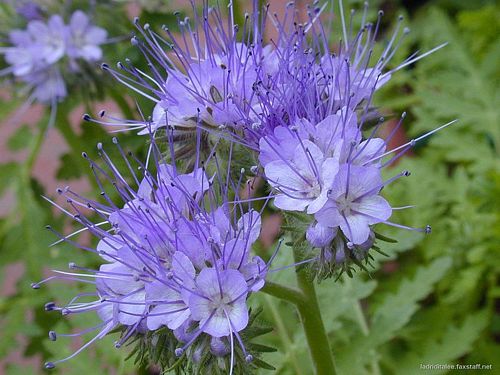
Lacy Phacelia (Phacelia tanacetifolia) is an annual plant whose lovely lavender-blue flowers are very attractive to pollinators and other beneficial insects. The flowers are bell-shaped with long stamens that protrude beyond the petals. The flowers grow in clusters at the top of the stem. The deeply cut leaves give this plant its lacy appearance. Lacy Phacelia is a valuable pollinator plant and is especially favored by bees. It also attracts hoverflies, beneficial insects that eat aphids and other pests.
Lacy Phacelia is often planted in vineyards and next to crops because its nectar-rich flowers are attractive to bees and other pollinators. It is also used as a bee-friendly cover crop on organic farms. In the garden, it does best in full sun and well-draining sandy soil. This plant has a fast growth rate. Be aware that some people can experience skin irritation after touching this plant.
Annual herb
2 - 4 ft Tall
2 ft Wide
Upright
Fast

Blue
Spring
Deer resistant
Full Sun
Very Low
Max 1x / month once established
Moderate
Tolerates cold to 10° F
Fast
Prefers sandy soil.
Soil PH: 6.0 - 7.5
For propagating by seed: No treatment. Sow outdoors in late fall or germinate in cool temperatures (59° to 70°F) in darkness first 24 hours. (Schulz and Klein 1963).
7*, 8*, 9*, 10*, 11*, 12*, 14*, 15*, 16*, 17*, 18*, 19*, 20*, 21*, 22*, 23*, 24*
Sandy gravelly slopes, open places in chaparral or woodland below 7500 feet.
Chaparral, Foothill Woodland, Valley Grassland, Yellow Pine Forest
Use for spaces between chaparral shrubs along with other annuals or perennial herbs such as Poppy (Eschscholzia spp. or Papaver spp.), Baby Blue Eyes (Nemophila menziesii), Cream Cups (Platystemon californicus), and with geophytes such as Onion (Allium spp.), Mariposa Lily (Calochortus spp.), and Blue Dicks (Dichelostemma capitatum). Also useful around various cacti and succulents such as Dudleya spp.
Butterflies and moths supported
0 confirmed and 9 likely
Geranium Plume Moth
Amblyptilia pica
Oso Flaco Flightless Moth
Areniscythris brachypteris
Orange Tortrix Moth
Argyrotaenia franciscana
Lady Bird Johnson Wildflower Center - the University of Texas at Austin. (n.d.). https://www.wildflower.org/plants/result.php?id_plant=PHTA,%20https://www.xerces.org/blog/midsummer-management-of-crop-pests-and-pollinators