

Carried by 3 nurseries
View Availability at NurseryData provided by the participants of the Consortium of California Herbaria
View additional distribution information on the Jepson eflora
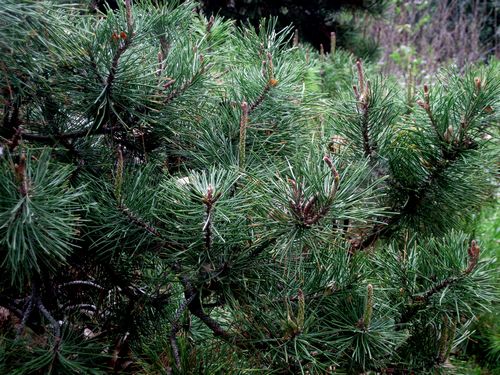
Pinus contorta is a common tree in western North America with the bulk of its population to the north and east of California. Within California it is found primarily in the Sierras, with scattered populations in other mountains. There are three recognized subspecies which can vary greatly in appearance. In the Sierras ssp. Murrayana can be very tall with a straight trunk, consistent with the common name Lodgepole Pine. It is found at elevations from 1,500 ft. to 12,000 ft. Near the coast ssp. contorta can be shrub height with twisted trunk and branches and known as Beach Pine. It is found from sea level to about 2,000 ft. Ssp. bolanderi is a rare species from the coast of Mendocino County northward to Oregon.
Pinus contorta is a moderately important timber wood but not often used in landscaping. The needles are held in bundles of two. The cones of may be of either the closed or open type and remain on the tree for many years. The bark is relatively thin and susceptible to fire.
Tree
30 - 112 ft Tall
40 ft Wide
Upright
Fast
Evergreen
Pleasant

Yellow
Summer
Bank stabilization, Hedge
Full Sun, Partial Shade
Moderate
Max 3x / month once established
Easy
Tolerates cold to -20° F
Fast, Medium, Slow
Tolerates a wide variety of soils.
Soil PH: 5.0 - 7.0
Prune in winter when wood boring insects are less active.
For propagating by seed: Fresh seeds need no treatment; stored seeds 1 mo. stratification ( USDA Forest Service 1974 ).
Settings range from the low elevation, wind-swept north coast to the high elevation forests of the Sierras.
Closed-cone Pine Forest, Coastal Strand, Wetland-Riparian
In the wild Pinus contorta is found with Serviceberry (Amelanchier spp.), Manzanita (Arctostaphylos Klamathensis or nevadensis), Ceanothus cordulatus or velutinus, Bush Chinquapin (Chrysolepis sempervirens), Ocean Spray (Holodiscus discolor), Juniperus spp., Honeysuckle (Lonicera spp.), Currant/Gooseberry (Ribes spp.), and Huckleberry (Vaccinum spp.)
Butterflies and moths supported
38 confirmed and 66 likely
Western Pine Elfin
Callophrys eryphon
Pale Beauty
Campaea perlata
Red Girdle Moth
Caripeta aequaliaria