

Carried by 29 nurseries
View Availability at NurseryData provided by the participants of the Consortium of California Herbaria
View additional distribution information on the Jepson eflora
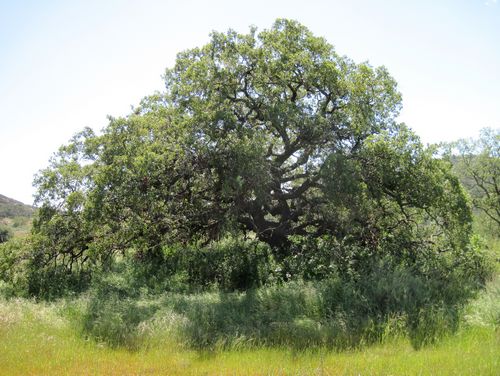
Engelmann oak (Quercus engelmannii) is a moderately fast-growing tree, typically evergreen but sometimes drought-deciduous in hot summers. Native to Southern California, this rare oak has lost much of its range due to suburban development. It primarily survives in San Diego County, with smaller populations in Pasadena, Orange County, southern Riverside County, and Baja California.
This oak thrives above the dry coastal plain but below 4,200 feet, where winters can be colder. Its thick, leathery blue-green leaves provide year-round color and complement gray-green landscapes. Mature trees develop stunning, gnarled trunks and wide-spreading branches, making them a striking addition to open spaces.
Engelmann oak can be tricky to grow—it prefers dry soil but stays green year-round if it has access to groundwater or nearby irrigation. It requires plenty of space, full sun, and tolerates various soil types.
As a keystone species, Engelmann oak supports an extensive array of butterflies and birds, playing a vital role in Southern California ecosystems. It pairs well with native plants like ceanothus, coffeeberry, and silktassel.
Tree
33 - 66 ft Tall
90 ft Wide
Rounded
Moderate
Evergreen, Summer Semi-deciduous
None

Green, Cream
Spring, Winter
Bank stabilization, Deer resistant
Full Sun, Partial Shade
Very Low, Low
Max 2x / month once established
Easy
Tolerates cold to 30° F
Fast, Medium, Slow
Tolerates a variety of soils including deep loamy-clay soils and shallow rocky soils.
Soil PH: 6.0 - 8.0
By acorns. For propagating by seed: Fresh seeds sow in fall outdoors or stratify to hold for spring sowing. (USDA Forest Service 1974.)
3, 5, 7, 8, 9, 14*, 15*, 16*, 17, 18*, 19*, 20*, 21*, 22, 23, 24
Gentle rocky slopes, grassy mesas with plenty of ground water or just upslope from riparian woodlands, most often as the dominant species in Englemann Oak Woodland. Also found in conjuction with chaparral or valley grassland.
Chaparral, Foothill Woodland, Southern Oak Woodland, Valley Grassland
Often found with Coast Live Oak (Quercus agrifolia). Understory plants include Sages (Salvia spp.), native grasses, and perennial or annual wildflowers. Where adjacent to riparian woodlands, its associates include willows (Salix spp.), Cottonwoods (Populus spp.), and California Sycamore (Platanus racemosa).
Butterflies and moths supported
1 confirmed and 111 likely
Pacific Tent Caterpillar
Malacosoma constricta