

Carried by 21 nurseries
View Availability at NurseryData provided by the participants of the Consortium of California Herbaria
View additional distribution information on the Jepson eflora
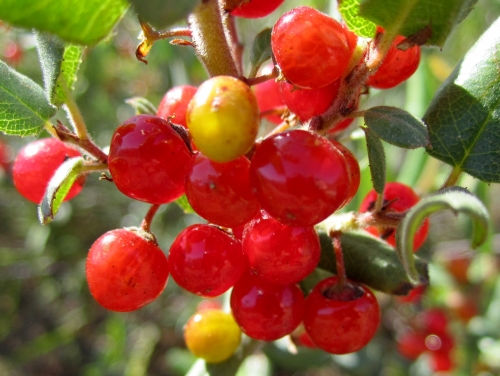
Hollyleaf Redberry (Rhamnus ilicifolia) is an evergreen native shrub that grows in the foothills and mountains of southern and central California, the Sierra foothills, and the foothills west of Sacremento Valley. It primarily grows at elevations from 500 to 6600 feet. It was formerly considered a subspecies of Rhamnus crocea but is now considered a separate species. Their ranges overlap considerably, and they resemble each other superficially.
This plant is reasonable to grow if properly sited. Plant in part shade or full sun on rocky slopes, or at least with plenty of rocks surrounding it. It seems to prefer part shade in the drier parts of its range.
It can tolerate summer water up to 1x per month. However once established, it's usually happiest without any supplementary water, but in a spot where it can run its roots over to an irrigated area or a place with a little more natural moisture, such as a creek or rain gully. The flowers are inconspicuous; the plant is grown primarily for its springtime bright and shiny red berries. These berries are an important food source for birds.
This plant has small leaves with sharp points along their edges, resembling small holly leaves (thus its common name). These leaves give this plant significant deer resistance. This shrub is quite versatile in garden landscapes, from wildlife habitat to erosion control to hedges and barriers.
In optimal conditions, Hollyleaf Redberry can grow from a 1-gallon container to 3 feet tall in two years.
Shrub
1 - 9 ft Tall
3 - 9 ft Wide
Mounding
Slow
Evergreen

Yellow, Cream
Winter, Spring
Bank stabilization, Hedge
Full Sun, Partial Shade
Low, Very Low
Max 1x / month once established
Easy
Tolerates cold to 0° F
Fast, Medium
Tolerates a variety of soils but prefers rocky well-drained soil.
Soil PH: 6.0 - 7.5
For propagating by seed: Fresh seeds need no treatment; stored seeds 2.5 to 3 months stratification.
7*, 9*, 14*, 15*, 16*, 17*, 18*, 19*, 20, 21, 22, 23
Rocky slopes, canyons as part of Chaparral, Oak Woodland, and Ponderosa Pine Forest
Chaparral, Oak Woodland, Yellow Pine Forest
Coast Live Oak (Quercus agrifolia), Scrub Oak (Quercus berberidifolia), Woolly Bluecurls (Trichostema lanatum), Climbing Penstemon (Keckiella cordifolia), California Encelia (Encelia californica), California Buckwheat (Eriogonum fasciculatum), Coast Sagebrush (Artemisia californica), Sage (Salvia spp.), Manzanita (Arctostaphylos spp.), Yucca species, Dudleya species, and cactus species
Butterflies and moths supported
0 confirmed and 19 likely
Polyphemus moth
Antheraea polyphemus
Oblique-Banded Leafroller Moth
Choristoneura rosaceana
Common Eupithacia
Eupithecia miserulata