

Carried by 34 nurseries
View Availability at NurseryData provided by the participants of the Consortium of California Herbaria
View additional distribution information on the Jepson eflora
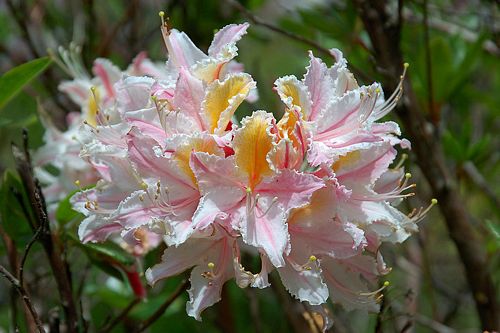
Western Azalea is best known of three Rhododendron species native to California. It occurs as far north as Bandon, Oregon and as far south as the Palomar Mountain area in southern California, possibly also in Baja California, Mexico. It is a shrub capable of growing to 5 meters tall but more commonly around 3 meters. The leaves are deciduous, 3-9 centimeters long and 1-3 centimeters broad. The flowers are 3.5-5 centimeters in diameter, with five lobes on the corolla; color varies from white to pink, often with a yellow blotch. It is most often found in moist forested areas. It typically gets summer fog drip or some other source of summer moisture. It is deciduous and will be leafless for some months out of the year, but does produce interesting fall color. It needs some sun for good flower production but also likes some high shade such as the edge of a woodland.
Shrub
6 - 16 ft Tall
10 ft Wide
Upright, Rounded
Moderate
Winter Deciduous
Pleasant

White, Pink
Spring
Containers
Partial Shade
High, Moderate
Max 1x / week once established
Tolerates cold to -10° F
Slow
Prefers deep woodland soil with high organic content, can be acidic such as peat or pine needles.
Tolerates sodic soil..
Soil PH: 4.0 - 8.0
Some occasional thinning of branches may be needed to keep an attractive, open structure. Prune in winter when the plant is dormant
Seeds, cuttings or layering. For propagating by seed: No treatment. Best sown on milled sphagnum moss.
3, 4*, 5*, 6*, 7*, 14*, 15*, 16*, 17*, 19, 20, 21, 22, 23, 24
Streambanks, seeps, wet meadows or other moist areas within or adjacent to forest or woodlands, typically in mountainous areas
Wetland-Riparian
Other woodland species including Wild Ginger (Asarum caudatum), Ceanothus species, Pacific Bleeding Heart (Dicentra formosa), California Coffeeberry (Frangula californica), Alumroot (Heuchera micrantha), Oceanspray (Holodiscus discolor), Tanoak (Notholithocarpus densiflorus), Pines (Pinus spp.), Oaks (Quercus spp.), Gooseberries (Ribes spp.), Fringecups (Tellima grandiflora), and Huckleberry (Vaccinum species).
Butterflies and moths supported
2 confirmed and 23 likely
Green Comma
Polygonia faunus
Hoary Comma
Polygonia gracilis
Sallow Button
Acleris hastiana
Miranda Underwing
Amphipyra pyramidoides