

Carried by 65 nurseries
View Availability at NurseryData provided by the participants of the Consortium of California Herbaria
View additional distribution information on the Jepson eflora
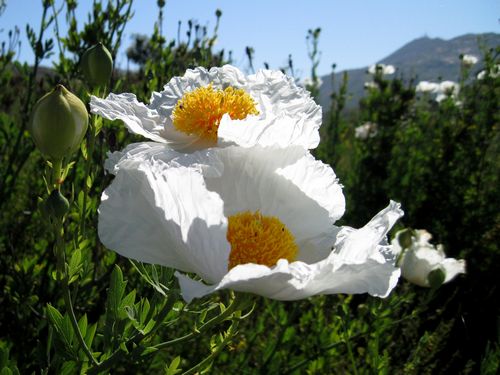
Coulter's Matilija Poppy (Romneya coulteri) is one of the largest and showiest California poppies. Large white petals with a crinkled texture surround yellow stamens, giving this poppy a bright, cheerful appearance. Its flowers, which can be as large as 7 inches across, are attractive to bees and butterflies.
This plant can be challenging to establish, as it can suffer from both too much and too little water. Once established, however, it readily spreads by rhizomes and can soon outgrow its intended area. (Pulling shoots usually suffices to control it.) Plant in full sun in well-draining, sandy soil. Matilija Poppy is a low-water plant that does not need supplemental summer irrigation once established.
Perennial herb
7 - 10 ft Tall
20 ft Wide
Upright Columnar, Weeping
Moderate
Summer Deciduous
None

Yellow, White
Summer, Spring
Deer resistant, Groundcover
Full Sun
Very Low, Low
Never irrigate once established
Easy
Tolerates cold to -6° F
Fast, Medium
Prefers sandy or gravelly soil with fast drainage.
Soil PH: 5.0 - 8.0
It is advisable to cut down to 6 inches in late Summer or Fall. Dried leaves and stalks make excellent mulch when chopped or broken up
Usually by rhizomes during winter. Disturbing the rhizomes at other times is usually fatal. Propagation by seeds is difficult. For propagating by seed: Fire treatment in late fall and germinate outdoors; or soak in l N potassium hydroxide (KOH) 1/2 hr., then soak in 100 ppm GA3 overnight. Soaking in KOH followed by 3 mos. stratification, then GA3 may improve germination ( Harrington 1975). 3 mos. stratification gives some germination.
4*, 5*, 6, 7*, 8*, 9*, 10, 11, 12, 14*, 15*, 16*, 17*, 18*, 19*, 20*, 21*, 22*, 23*, 24*
Dry washes, canyons and foothills, with chaparral or coastal sage scrub vegetation
Chaparral, Coastal Scrub, Lowland Chaparral, Southern Coastal Scrub
Grows well with a wide variety of chaparral plants including Scrub Oaks, Manzanitas, Coyote Brush (Baccharis pilularis ssp. pilularis), Laurel Sumac (Malosma laurina), Chaparral Mallow (Malacothamnus fasciculatus), Toyon (Heteromeles arbutifolia), and Lemonade Berry
Butterflies and moths supported
0 confirmed and 1 likely
Bornstein, C., Fross, D., O'Brien, B. (2005). California Native Plants for the Garden. Cachuma Press.