

Carried by 23 nurseries
View Availability at NurseryData provided by the participants of the Consortium of California Herbaria
View additional distribution information on the Jepson eflora
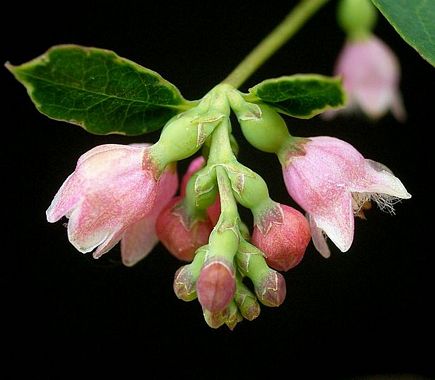
Snowberry (Symphoricarpos albus) is a deciduous shrub in the honeysuckle family known for its delicate bell-shaped pink flowers in spring and clusters of white berries in fall and winter. Native to moist, shady areas, it thrives as an understory plant in woodlands and along streambanks, forming dense thickets when conditions are favorable.
In the garden, snowberry is an excellent choice for dry shade, though it also tolerates additional water. Its adaptability makes it well-suited for a variety of soils and moisture levels. The shrub provides valuable shelter for wildlife, while its berries serve as a favorite food source for birds. Although the berries are mildly toxic to humans, they are harmless to many animals.
The spring blooms are a reliable source of nectar for bees, butterflies, and hummingbirds, adding to its appeal as a habitat-friendly addition to native plant gardens.
Shrub
3 - 6 ft Tall
6 ft Wide
Rounded, Fountain
Fast, Moderate
Winter Deciduous
None

Pink, White
Summer, Spring
Bank stabilization, Groundcover, Hedge
Partial Shade, Deep Shade
Low
Max 3x / month once established
Easy
Tolerates cold to 0° F
Medium
Tolerates a variety of soils.
Soil PH: 5.0 - 7.0
To control spread, prune rhizomes from unwanted areas in winter.
Easiest to propagate from rhizome cuttings. For propagating by seed: Soak in concentrated H2 S04 1 hr. (or 3-4 mos. warm stratification) and 4-6 mos. cold
Moist, shady places in the Coast Ranges, Central Valley, Sierras and foothills, Transverse Range and Peninsular Range. It is most commonly found in forested or woodland habitats.
Foothill Woodland, Mixed Evergreen Forest, Yellow Pine Forest
Use with other woodland plants such as Dogwood (Cornus spp.), Pines or Firs (Pinus spp. or Abies spp.), wild rose (Rosa spp.), native ferns, Oaks (Quercus spp.), and other trees, as well as larger chaparral shrubs such as Toyon (Heteromeles arbutifolia)
Butterflies and moths supported
10 confirmed and 19 likely
Orange Tortrix Moth
Argyrotaenia franciscana