

Carried by 35 nurseries
View Availability at NurseryData provided by the participants of the Consortium of California Herbaria
View additional distribution information on the Jepson eflora
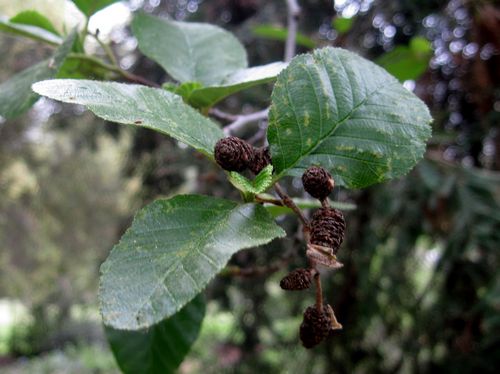
White alder (Alnus rhombifolia) is a fast-growing deciduous tree in the birch family (Betulaceae), native to western North America at elevations of 300–7,900 feet. It thrives in moist soils, often found along streambanks and other wet areas.
This tree provides excellent shade, with dark green leaves in summer that drop in winter. In early spring, before the leaves emerge, white alder produces noticeable male catkins, which hang in clusters and release large amounts of pollen. The female catkins mature in autumn, resembling small cones that may persist on the tree for up to a year.
White alder is heat and wind tolerant but requires deep watering to establish. Its roots can be invasive, so it should be planted with caution, especially near structures or small residential gardens. However, it is an excellent choice for woodland plantings and riparian areas.
This tree has high wildlife value. It serves as a larval food plant for the Western Tiger Swallowtail butterfly and provides habitat and food for various bird species.
Tree
49 - 82 ft Tall
35 ft Wide
Upright, Rounded, Upright Columnar
Fast
Winter Deciduous
Pleasant

Green, Cream
Summer, Fall
Full Sun, Partial Shade
High
Keep moist
Fast, Medium, Slow
Tolerant of sand and clay.
Soil PH: 4.0 - 8.0
1*, 2*, 3*, 4, 5, 6, 7*, 8, 9*, 10, 14*, 15*, 16*, 17*, 18*, 19, 22*, 23*, 24*
Usually found in wetland such as permanent stream edges, often adjacent to other vegetation such as chaparral, redwood forest, pine forest, and foothill woodland
Chaparral, Foothill Woodland, Forest, Yellow Pine Forest, Wetland-Riparian
Wetland-riparian trees and plants including Maples (Acer spp.), Dogwood (Cornus spp.), Ash (Fraxinus spp.), Walnut (Juglans spp.), Western Sycamore (Platanus racemosa), Cottonwood (Populus spp.), Willow (Salix spp.), Spicebush (Calycanthus occidentalis), Wild Honeysuckle (Lonicera spp.), Wild Azalea (Rhododendron spp.), Wild Currant (Ribes spp.), Wild Rose (Rosa spp.), and Wild Grape (Vitis spp.).
Butterflies and moths supported
2 confirmed and 134 likely
Western Tiger Swallowtail
Papilio rutulus
Large Red-belted Clearwing Moth
Synanthedon culiciformis