

Carried by 7 nurseries
View Availability at NurseryData provided by the participants of the Consortium of California Herbaria
View additional distribution information on the Jepson eflora
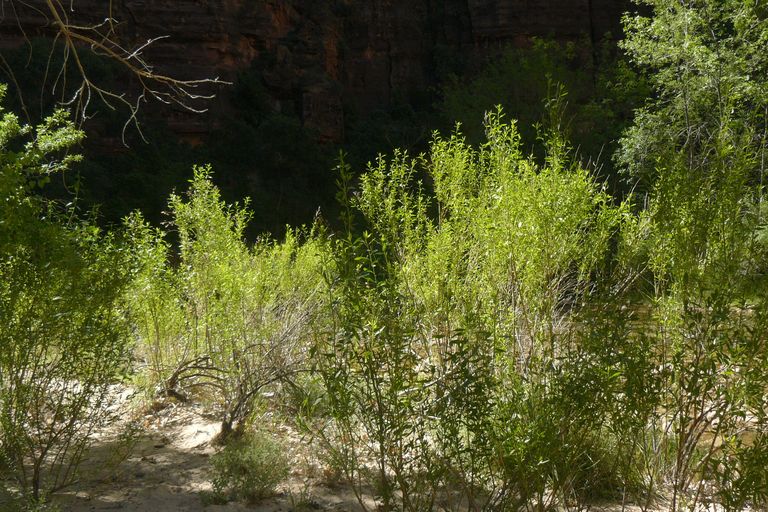
Baccharis emoryi is a species in the Asteraceae (Sunflower) family known by the common name Emory's Baccharis. It is native to the southwestern United States and northern Mexico, where it grows in sandy, moist habitat such as riverbanks or alkali marsh, but also occasionally in more xeric areas. In California it is found in the southern half of the state. This is a shrub producing erect, branching stems approaching three meters in maximum height. The thick leaves are oblong to oval in shape and sometimes have roughly toothed edges. They may be up to 7 centimeters long. The shrub is dioecious, with male and female plants producing flower heads of different types. The head is enclosed in a layer of phyllaries and the female flowers yield fruits, each an achene with a white pappus about a centimeter long. The foliage and flower heads are hairy and sticky. This species is very similar to its relatives, Baccharis pilularis and Baccharis salicifolia. It's a good choice for a bioswale, edge of a pond, alkaline soil patches, or where rapid growth is desired and its tendency to spread can be accommodated.
Shrub
3 - 10 ft Tall
7 ft Wide
Upright
Fast
Summer Semi-deciduous

Cream, White
Winter, Summer, Fall
Hedge
Full Sun
Low, Moderate, High
Max 1x / week once established
Easy
Tolerates cold to 15° F
Fast, Medium, Slow
Tolerates a variety of soils as long as adequate moisture is present.
Tolerates sodic soil..
Soil PH: 6.0 - 8.5
Sandy edges of rivers and washes, salt marshes, alkaline flats
Coastal Sage Scrub, Creosote Bush Scrub, Wetland-Riparian
Use with other wetland plants such as Sedge (Carex spp.), Rush (Juncus spp.), and Willow (Salix spp.). In desert areas it may be used with Desert Willow (Chilopsis linearis)
Butterflies and moths supported
0 confirmed and 18 likely
Common Gray
Anavitrinella pampinaria
Orange Tortrix Moth
Argyrotaenia franciscana
Fatal Metalmark
Calephelis nemesis