

Carried by 0 nurseries
View Availability at NurseryData provided by the participants of the Consortium of California Herbaria
View additional distribution information on the Jepson eflora
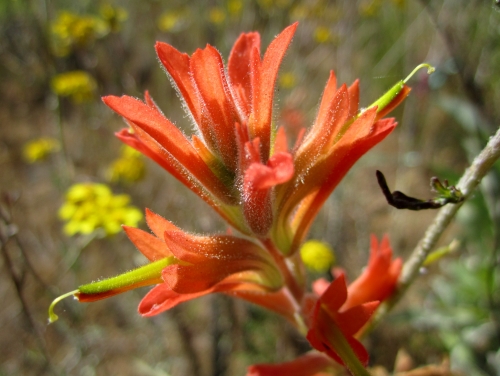
Indian Paintbrush is a species native to western North America from Washington to Baja California, where it grows on hills and mountains slopes along the coast and inland. This is a perennial herb growing an erect stem up to about 60 centimeters in maximum height. It is greenish to purple in color and may be hairless to quite hairy. The leaves are variable in shape and up to 8 centimeters long. The flower cluster is a series of leafs in shades of bright red to yellowish. Flowers appearing between the leafs are a bit longer and covered in hairs. They are green to purple lined with red or yellow. The fruit is a capsule just over a centimeter long. There are three subspecies of this plant (ssp. affinis, ssp. litoralis, & ssp. neglecta). Ssp. affinins (Coast Indian painbrush) occurs commonly throughout western North America from Washington to Baja California. Ssp. litoralis and ssp. neglecta are quite rare. Ssp. littoralis (Oregon Coast paintbrush) grows on the coastline of northern California and Oregon and ssp. neglecta (Tiburon paintbrush) is known from only a few occurrences in and around the San Francisco Bay Area and is a federally listed endangered species. Castilleja is a hemi-parasite, meaning that it derives some of its nutrients from a host plant.
Annual herb, Perennial herb
2 ft Tall
Upright

Orange, Red, Yellow
Full Sun
Challenging
Tolerates cold to 5° F
Rocky soil with sand.
Soil PH: 5.5 - 8.2
Since Castilleja is a hemi-parasite, planting it along with host plants such as lupine or bunch grasses may improve growth. Host plants are often very specific and can be difficult to choose, but try associates found in Castilleja's natural community such as Eriophyllum stachaedifolium (Lizard tail), Eriogonum parvifolium (Seacliff buckwheat), or Erigeron glaucus (Seaside daisy).
Sea bluffs, hillsides, dry places
Coastal Strand
Plant alongside other plants of the coastal scrub/chapparal community, such as Coyote Bush (Bacharris Piluaris), Coast Buckwheat (Eriogonum latifolium), and Checker Bloom (Sidalcea malviflora).
Butterflies and moths supported
2 confirmed and 13 likely
Orange Tortrix Moth
Argyrotaenia franciscana
Leanira Checkerspot
Chlosyne leanira
Geranium Plume Moth
Amblyptilia pica