

Carried by 6 nurseries
View Availability at NurseryData provided by the participants of the Consortium of California Herbaria
View additional distribution information on the Jepson eflora
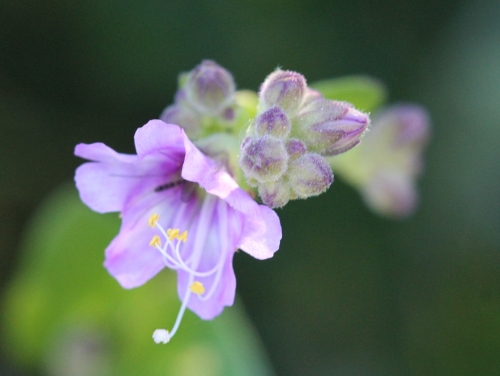
California Four O'Clock (Mirabilis laevis var. crassifolia) is a common native perennial herb that grows in Southern and Central California, primarily in the Central Coast, the South Coast Range and South Coast regions. It tends to grow in grassy places, at elevations from 0-3300 feet. The plant form is dense and mounding, producing a large number of small brightly colored flowers ranging from pink to purple. The plant sometimes goes deciduous in the summer, leaving only winding white twigs until the next rainy season. It may retain some foliage in shady locations and with occasional summer water. It is sometimes difficult to establish, but once established it require little or no attention. It spreads by runners and readily reseeds in native plant gardens.
Perennial herb
3 ft Tall
10 ft Wide
Spreading
Moderate
Summer Semi-deciduous, Winter Deciduous
None

Lavender, Pink, Purple
Winter, Spring
Groundcover
Full Sun, Partial Shade
Low, Very Low
Max 1x / month once established
Moderate
Tolerates cold to 30° F
Fast, Medium, Slow
Adaptable.
Soil PH: 5.0 - 8.0
The stems are fragile and break off easily. It can be pruned or sheared in late summer or early fall to restrain its spreading tendency
8*, 9*, 14*, 15*, 16*, 17*, 18*, 19*, 20*, 21*, 22*, 23*, 24*
Grassy places, slope bottoms, dunes, dry rocky places and washes, or in the understory of taller chaparral plants
Chaparral, Coastal Sage Scrub, Foothill Woodland
Works well with most chaparral and coastal sage scrub plants such as tree or scrub Oaks (Quercus spp.), Toyon (Heteromeles arbutifolia), Lemonade Berry (Rhus integrifolia), Black Elderberry (Sambuccus nigra), Manzanita species and Ceanothus species.
Butterflies and moths supported
1 confirmed and 7 likely
Somber Carpet
Disclisioprocta stellata