

Carried by 14 nurseries
View Availability at NurseryData provided by the participants of the Consortium of California Herbaria
View additional distribution information on the Jepson eflora
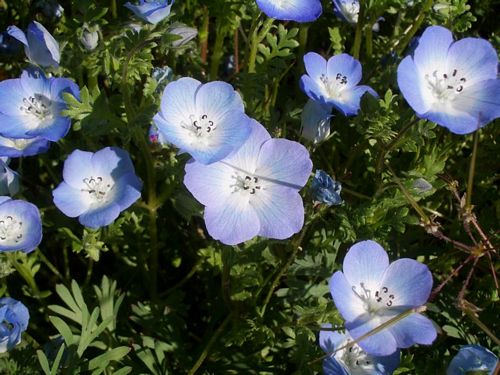
Baby Blue Eyes (Nemophila menziesii), a common annual of California, Oregon, and Baja California, is a popular garden plant. It is a spring-blooming wildflower that gets its name from the bright blue flowers of two of the three varieties that are recognized. One variety, var. atomaria, is found in the north coast and has almost pure white flowers.
It can occasionally be found outside its native range as an introduced species, in Alaska, for example. Baby Blue Eyes grows virtually throughout California at heights from sea level up to almost 6500 feet in many types of habitat. It is easy to grow from seed along with other annuals in a wildflower meadow or in openings between trees and shrubs.
Annual herb
6 in Tall
6 in Wide

Blue
Spring
Containers
Full Sun, Partial Shade
Low
Max 2x / month once established
Moderate
Tolerates cold to 5° F
Fast, Medium
Sandy to loamy.
Soil PH: 6.0 - 8.0
By seed. For propagating by seed: If sown outdoors in late fall, no treatment may give good results. Germinate at 59°F (Association of Official Seed Analysts 1981); or at cool temperature (less than 70°F) and in darkness first 3 days (Chen 1968; Cruden 1974).
Meadows, grassy places and canyons
Chaparral, Coastal Sage Scrub, Creosote Bush Scrub, Foothill Woodland, Joshua Tree Woodland, Mixed Evergreen Forest, Northern Coastal Scrub, Northern Oak Woodland, Forest, Southern Oak Woodland, Valley Grassland, Yellow Pine Forest
Use with other wildflowers such as California Poppy (Eschscholzia californica), Clarkia spp., and Sidalcea spp., with geophytes such as Brodiaea spp., Mariposa Lily (Calochortus spp.), and Blue Dicks (Dichelostemma capitatum), and with succulents such as Dudleya spp. and various cactus species.
Butterflies and moths supported
1 confirmed and 4 likely
Alfalfa Looper Moth
Autographa californica
Funereal Duskywing
Erynnis funeralis