

Carried by 13 nurseries
View Availability at NurseryData provided by the participants of the Consortium of California Herbaria
View additional distribution information on the Jepson eflora
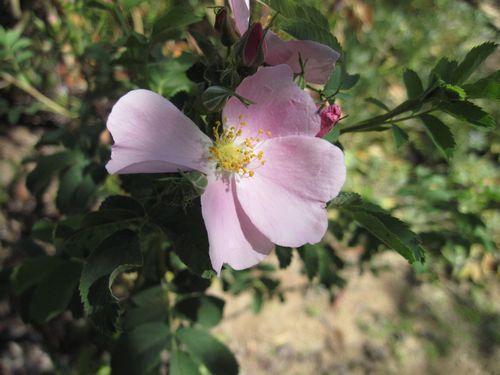
Woods' Rose (Rosa woodsii) is a native shrub that grows in Northern, Southern and Central California, primarily in mountainous areas including the Cascades, Sierra Nevada and Transverse Ranges. It is fast growing and long-lived, grows in an upright form to a height of 3 feet, with active growth during the spring and summer. Flowers are pink, striking and very fragrant, and bloom in the late spring. Leaves are medium green and deciduous. It tends to grow in moist places, at elevations from 3500-11500 feet. It has straight sharp thorns.
Woods' Rose needs moisture, but once established can be watered once a month in the summer. It tolerates clay but does best in moist loamy soil. Because of the spines and its tendency to sprawl, it can be pruned annually in winter.
Birds are attracted to the fruits, and Woods? Rose hosts a number of butterflies & moths, a likely total of 58.
Shrub
3 - 9 ft Tall
15 ft Wide
Upright, Spreading
Fast
Winter Deciduous
Pleasant

Red, Pink
Spring
Groundcover, Deer resistant
Partial Shade, Full Sun
Moderate, High
Max 1x / month once established
Easy
Tolerates cold to -10° F
Medium, Slow
Tolerates clay but does best in moist loamy soil.
Soil PH: 6.0 - 8.0
Because of the spines and its tendency to sprawl, it can be pruned annually in winter to shape
Moist places and streambanks of higher elevations, typically with cold winters
Joshua Tree Woodland, Lodgepole Forest, Pinyon-Juniper Woodland, Red Fir Forest, Subalpine Forest, Yellow Pine Forest, Wetland-Riparian
Use with other plants of moist areas and high elevation, such as Dogwood (Cornus spp.), Oceanspray (Holodiscus discolor), Honeysuckle (Lonicera spp.), Currant (Ribes spp.), and Western Serviceberry (Amelanchier utahensis).
Butterflies and moths supported
0 confirmed and 58 likely
Garden Webworm Moth
Achyra rantalis
Destructive Pruneworm Moth
Acrobasis tricolorella
Yellow-Haired Dagger Moth
Acronicta impleta