

Carried by 32 nurseries
View Availability at NurseryData provided by the participants of the Consortium of California Herbaria
View additional distribution information on the Jepson eflora
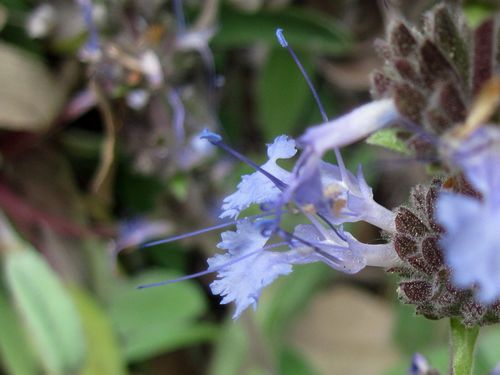
Sonoma Sage or Creeping Sage is a member of the Lamiaceae (Mint) family native to California. It is found in the Coast Ranges, Peninsular Range, and Sierra foothills. As suggested by its common name, it is a mat-forming subshrub with stems growing no more about 40 centimeters high. The leaves are about 3-6 centimeters long and.5 to 1.5 centimeters wide; they are hairy, the upper surface with minute hairs, and the lower surface so densely covered with recurved hairs that it looks white. The flower clusters are scapose, with clusters 1 to 1.5 centimeter wide. The flowers range in color from white to blue, lilac and purple. It is moderately drought tolerant if given some shade. It is sensitive to heat and direct sun; leaf drop is an indication of too much sun or heat or inadequate moisture. In suitable growing conditions it will forma mat up to 15 ft. wide while remaining about 1 ft. high.
Shrub, Perennial herb
1 ft Tall
5 - 15 ft Wide
Spreading
Moderate
Evergreen
Pleasant

Blue, Lavender, Purple, White
Spring, Summer
Deer resistant, Groundcover, Lawn alternative
Full Sun, Partial Shade
Extremely Low, Very Low
Max 3x / month once established
Tolerates cold to 10° F
Medium
Tolerates a variety of soils as long as drainage is adequate.
Tolerates serpentine soil..
Soil PH: 5.0 - 7.5
For propagating by seed: 3 mos. stratification or soak in 100 ppm GA3 1 hr., then dry and sow within 1wk. (Nord et al. 1971). If a longer storage period is needed between treatment and sowing, use either a longer soaking period or higher concentration of up to 500 ppm ( USDA Forest Service 1974).
7*, 14, 15*, 16*, 17*, 18*, 19, 20, 21, 22, 23, 24
Dry slopes in the understory of larger chaparral shrubs, oaks, pines, or other trees at elevations below 5, 000 ft.
Chaparral, Northern Oak Woodland, Yellow Pine Forest
Use with shrubs or trees from its native ranges, such as larger Ceanothus spp., Toyon (Heteromeles arbutifolia), Scrub Oak (Quercus berberidifolia or dumosa), tree Oaks (Quercus spp.), and various Pines (Pinus ponderosa and others)
Butterflies and moths supported
2 confirmed and 9 likely
California Pyrausta Moth
Pyrausta californicalis
Volupial Pyrausta Moth
Pyrausta volupialis
Climbing Cutworm
Abagrotis orbis