

Carried by 4 nurseries
View Availability at NurseryData provided by the participants of the Consortium of California Herbaria
View additional distribution information on the Jepson eflora
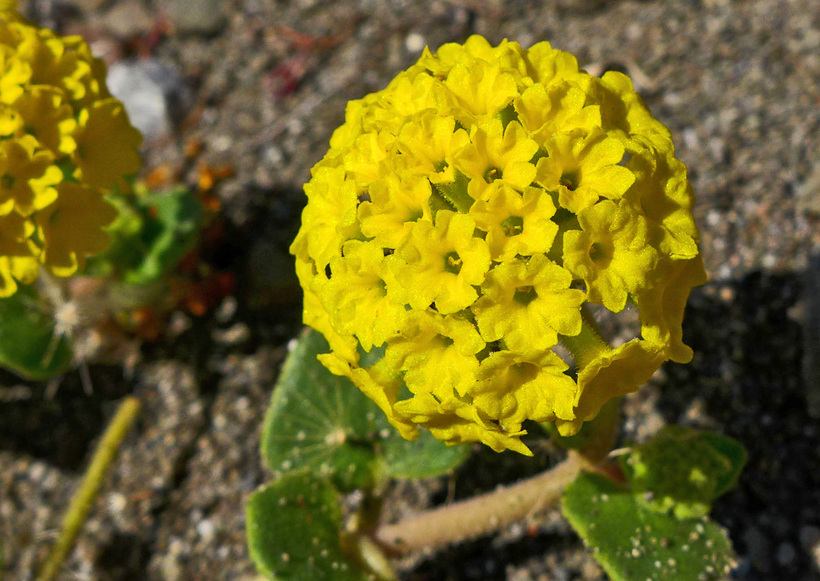
Sand Verbena (Abronia latifolia) is a species of the Four O'Clock Family (Nyctaginaceae) native to the west coast of North America, from Santa Barbara County to the Canadian border, where it grows on beach dunes and sand dunes of coastal bars, river mouths, spits along the immediate coastline (0-10m elevation). Its National Vegetation Community Status (NVCS) is the Ambrosia chamissonis herbaceous alliance (dune mat). It grows in succulent mats where it has room to spread. It is an important plant in helping to stabilize dunes and resist erosion. It grows from a stout, fleshy root structure which are edible, traditionally eaten by the Chinook Indians. When stressed it will die back to the root, to sprout again when conditions are more favorable. It has attractive neatly-rounded heads of small, bright golden flowers and small, winged fruits. The individual flowers have no petals being composed of yellow bracts forming a trumpet-shaped calyx about the stamens. If given the proper conditions it will flower most of the year. It is geared for salt spray and will not tolerate regular water nor extreme drought.
Perennial herb
6 in Tall
7 ft Wide
Spreading
Fast
Summer Deciduous

Yellow
Summer, Spring, Fall
Full Sun
Very Low
Max 1x / week once established
Tolerates cold to 20 °F
Fast
Coarse to fine-textured sands; very loose and free of organic debris.
Tolerates saline soil..
Soil PH: 5.0 - 7.0
Dunes, coastal strand
Coastal Sage Scrub, Coastal Strand
Coastal plants such as other Verbena species - Red Sand Verbena (Abronia maritima), Pink Sand Verbena (Abronia umbellata), Common Yarrow (Achillea millefolium), Silver Beachweed (Ambrosia chamissonis), Beach Sage (Artemisia pycnocephala), Saltbush species (Atriplex spp.), Morning-glory species (Calystegia spp.), Beach Evening Primrose (Camissoniopsis cheiranthifolia), Sandcarpet (Cardionema ramosissimum), Croton (Croton californicus), Seaside Daisy species (Erigeron spp.), Buckwheat species (Eriogonum latifolium, Eriogonum parvifolium), Seaside Woolly Sunflower (Eriophyllum staechadifolium), Wallflower (Erysimum spp.), Beach Strawberry (Fragaria chiloensis), Coastal Gumplant (Grindelia stricta), Silky Beach Pea (Lathyrus littoralis), Dunedelion (Malacothrix incana), Hummingbird Sage (Salvia spathacea), Penstemon species, Sand Dune Bluegrass (Poa douglasii). Emergent shrubs may be present at low cover including Coyote Bush (Baccharis pilularis), California Goldenbush (Ericameria ericoides), Lupine species (Lupinus spp.).
Butterflies and moths supported
2 confirmed and 2 likely
Lithariapteryx Elegans
Lithariapteryx elegans
White-lined Sphinx
Hyles lineata