

Carried by 12 nurseries
View Availability at NurseryData provided by the participants of the Consortium of California Herbaria
View additional distribution information on the Jepson eflora
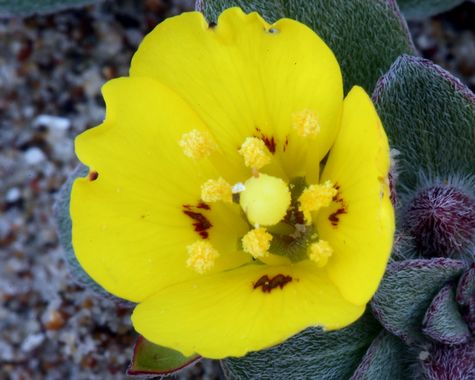
Beach primrose (Camissoniopsis cheiranthifolia), also known as beach suncup, forms sprawling carpets of vibrant yellow flowers on long, trailing stems that radiate from a central crown. The silvery grey-green leaves give the plant a soft, coastal aesthetic, while its four-petaled flowers, typical of suncups, open each morning and gradually fade from bright yellow to reddish by evening.
A member of the evening primrose family, beach primrose is native to the open dunes and sandy soils along the coastlines of California and Oregon. It is well adapted to harsh coastal conditions, with its prostrate growth and flexible stems allowing it to withstand wind and shifting sands. In its natural habitat, the plant typically goes dormant in summer, but in gardens with supplemental water, it may bloom year-round.
This resilient species plays a vital role in dune restoration projects. It helps stabilize sandy soils, shaping and maintaining dune structure while creating a habitat that supports a wide array of coastal wildlife. The flowers are an important food source for native bees and other pollinators, contributing to the biodiversity of coastal ecosystems.
Perennial herb
1 - 4 in Tall
6 - 36 in Wide
Mounding, Spreading
Fast
Evergreen

Red, Yellow
Summer, Spring, Winter
Lawn alternative
Full Sun
Very Low, Low
Max 1x / month once established
Moderate
Tolerates cold to 25 - 30° F
Fast
Sandy dunes.
Soil PH: 5 - 7
Reseeds readily
Coastal sandy slopes and flats, dunes
Coastal Strand
Coast Eriogonum (Eriogonum latifolium),Sand Verbena (Abronia spp.), Pt. Reyes Ceanothus (Ceanothus gloriosus), Twinberry (Lonicera involucrata), Lupine (Lupinus spp.), Bluff Lettuce (Dudleya farinosa), Coast Silktassel (Garrya elliptica), Yellow Stonecrop (Sedum spathulifolium), and Dune Manzanita (Arctostaphylos pumila), Coastal plants such as other Verbena species (Abronia maritima, Abronia umbellata), Common Yarrow (Achillea millefolium), Silver Beachweed (Ambrosia chamissonis), Beach Sage (Artemisia pycnocephala), Saltbush species (Atriplex spp.), Cakile maritima, Morning-glory species (Calystegia spp.), Sandcarpet (Cardionema ramosissimum), Croton (Croton californicus), Seaside Daisy species (Erigeron spp.), Buckwheat species (Eriogonum latifolium, Eriogonum parvifolium), Seaside Woolly Sunflower (Eriophyllum staechadifolium), Wallflower (Erysimum spp.), Beach Strawberry (Fragaria chiloensis), Coastal Gumplant (Grindelia stricta)
Butterflies and moths supported
0 confirmed and 4 likely
Ridings' Forester Moth
Alypia ridingsii
Phaeton Primrose Sphinx Moth
Euproserpinus phaeton
Clark's Day Sphinx Moth
Proserpinus clarkiae
Pacific Green Sphinx Moth
Proserpinus lucidus
Groundswell Ecology. (2021). Beach primrose (Camissonia cheiranthifolia) fact sheet. Groundswell Ecology. https://groundswellecology.org/wp-content/uploads/2021/10/12-BeachPrimrose-5x7-1.pdf
Golden Gate Bird Alliance. (n.d.). Beach dune ecosystem. Golden Gate Bird Alliance. https://goldengatebirdalliance.org/conservation/snowy-plovers/beach-dune-ecosystem/
Nature Collective. (n.d.). Beach primrose plant guide: Camissonia cheiranthifolia. Nature Collective. https://naturecollective.org/plant-guide/details/beach-primrose/
Theodore Payne Foundation. (n.d.). Camissonia cheiranthifolia ssp. suffruticosa. Theodore Payne Native Plant Database. https://theodorepayne.org/nativeplantdatabase/index.php?title=Camissonia_cheiranthifolia_ssp._suffruticosa