

Carried by 8 nurseries
View Availability at NurseryData provided by the participants of the Consortium of California Herbaria
View additional distribution information on the Jepson eflora
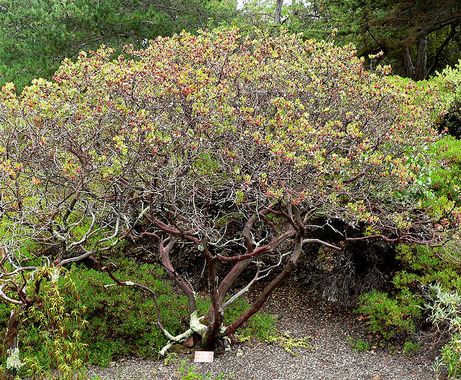
Arctostaphylos morroensis is a species endemic to California, where it is native to a very limited area of San Luis Obispo County and northern Santa Barbara County, from the vicinity of Morro Bay to Santa Maria. It is a spreading shrub, reaching up to 4 meters in height but usually less, and generally staying wider than tall. It has shreddy red-gray bark and whiskery bristles on the smaller branches and twigs. The leaves are oval-shaped and slightly convex, dark green on the upper surface and duller gray-green beneath. Plentiful flowers hang in dense clusters on short pedicels during the winter months. They are usually very light pink, urn-shaped, and hairy inside. The fruits are fuzzy red drupes each about a centimeter wide. This is a plant of the sandy coastal cliffs and beach chaparral. It is also cultivated as an ornamental.
Shrub
6 - 13 ft Tall
16 ft Wide
Mounding, Spreading
Evergreen

Pink, Brown
Spring, Winter
Deer resistant
Full Sun, Partial Shade
Low
Max 2x / month once established
Easy
Tolerates cold to 10° F
Fast
Prefers sand or sandstone.
Soil PH: 4.0 - 6.0
Prune to shape in dry weather to prevent infection
Seed or cuttings
Dunes and adjacent sandy areas, decomposed granite
Chaparral, Coastal Sage Scrub, Coastal Strand, Foothill Woodland
Use with other sand-tolerant coastal plants such as Sticky Monkey Flower (Mimulus auranticus), Santa Cruz Island Buckwheat (Eriogonum arborescens), Coast Buckwheat (Eriogonum latifolium), Cliff Buchwheat (Eriogonum parvifolium), Dune Lupine (Lupinus chamissonis), Holly-leaf Cherry (Prunus ilicifolia), Sage (Salvia spp.), Verbena (Abronia spp.), Beach Sage (Artemisia pycnocephala), Island Morningglory (Calystegia macrostegia), Beach Evening Primrose (Camissoniopsis cheiranthifolia), Seaside Golden Yarrow (Eriophyllum staechadifolium), White-flowered Goldenbush (Isocoma menziesii), Lupine (Lupinus spp.), and Cardinal Catchfly (Silene laciniata)
Butterflies and moths supported
0 confirmed and 23 likely
Western Avocado Leafroller Moth
Amorbia cuneana
Orange Tortrix Moth
Argyrotaenia franciscana