

Carried by 99 nurseries
View Availability at NurseryData provided by the participants of the Consortium of California Herbaria
View additional distribution information on the Jepson eflora
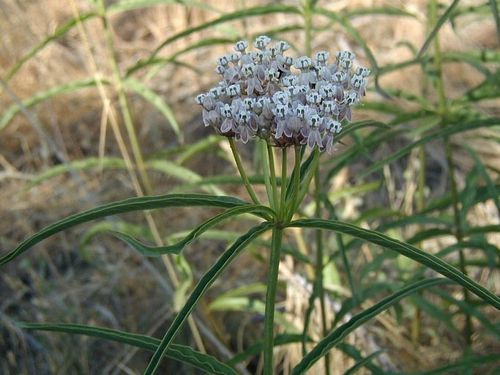
Narrowleaf Milkweed (Asclepias fascicularis) is a flowering perennial best known for the Monarch butterflies it will attract into the garden. Its long, thin pointed leaves give the plant a soft, wispy look. It blooms in summer to fall, with clusters of lavender or pinkish white flowers, each one an interesting button shape. The fruits are smooth pods, which split open to spill seeds along with plentiful silky hairs that may carry the seeds through the air.
This plant grows fast to 3 feet tall and is dormant in winter, often dying back to the ground. It will take full sun but is adaptable to most conditions, being easy to grow in soils with good drainage, even with no summer water. It can self-seed if the seed pods are not removed
This species is probably the single most important host plant for Monarch Butterflies in California, attracting them and hosting their caterpillars. It is crucial to not use any pesticide on or around the plant, because doing so will be fatal to the caterpillars. The plant also provides resources for many beneficial creatures, including native bees. Don't cut the dry stems down too soon as Orioles may use them for nesting.
Perennial herb
2 - 3 ft Tall
1 ft Wide
Winter Deciduous

Lavender, Pink, White
Summer, Fall
Containers, Deer resistant
Full Sun
Low, Very Low
Max 2x / month once established
Moderate
Tolerates cold to 5° F
Fast, Medium, Slow
Tolerates a variety of soils including sandy, clay and saline.
Tolerates saline soil..
Soil PH: 6.0 - 8.0
For propagating by seed: No treatment. Seeds need light to germinate, so just gently press them into the soil on their sides without burying them. Keep soil moist. Some seeds germinate in as little as 2 weeks after planting, but others in the same bed may continue to germinate for 1 to 2 months after that.
3*, 7*, 8*, 9*, 10, 14*, 15*, 16, 17, 18*, 19, 20, 21, 22, 23, 24
Found in many settings including valleys, foothills, canyons, mountains, often dry areas, occasionally in wetlands
Chaparral, Foothill Woodland, Lodgepole Forest, Red Fir Forest, Valley Grassland, Yellow Pine Forest, Wetland-Riparian
Works well with a wide variety of other plants but is best located where its winter leaf loss and summer consumption by caterpillars will not be the center of attention. Also, plant a number of milkweeds in proximity so caterpillars will have sufficient amounts to eat.
Use with showy, nectar-rich plants that will also attract adult Monarchs, such as Indian Mallow (Abutilon palmeri), Ceanothus species, Western Thistle (Cersium occidentale), California Aster (Corethrogyne filaginifolia), California Fuchsia (Epilobium canum), Buckwheat (Eriogonum spp.), Mint (Monardella spp.), Monkeyflower (Mimulus spp.), Penstemon spp., Sages (Salvia spp.), Apricot Mallow (Sphaeralcea ambigua).
Butterflies and moths supported
2 confirmed and 4 likely