

Carried by 4 nurseries
View Availability at NurseryData provided by the participants of the Consortium of California Herbaria
View additional distribution information on the Jepson eflora
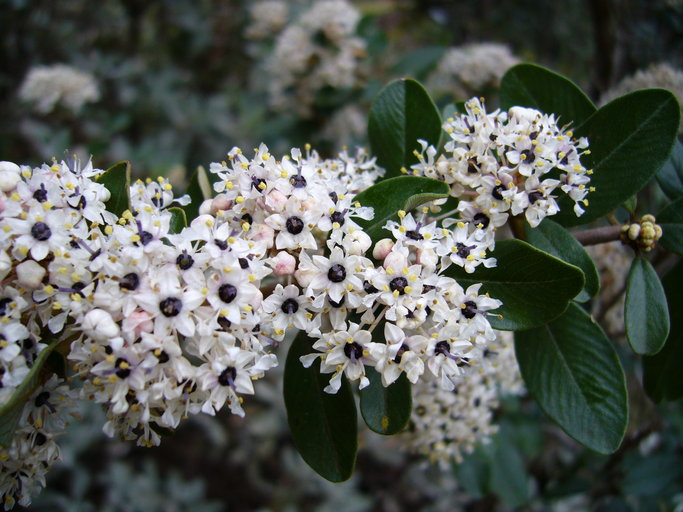
Ceanothus megacarpus is a species of flowering shrub in the Rhamnaceae (Buckthorn) family known by the common name Bigpod Ceanothus. This Ceanothus is endemic to California, where its distribution extends from Santa Barbara County to San Diego County and includes most of the Channel Islands. There are two recognized varieties; var. insularis is a rare form found primarily on the Channel Islands. This shrub may exceed 4 meters in height but usually less and is covered in thick oval to nearly rectangular evergreen leaves. The leaves may be either opposite or alternate, sometimes on the same plant. The flower clusters are small and sparse and are filled with small white to pale lavender flowers with dark centers. The fruit is a large, bumpy, spherical red-green capsule about a centimeter wide. The inside of the capsule is divided into 3 valves, each valve holding a seed. The capsule dehisces neatly in two at the central band to release the seeds. This is a showy plant in early spring.
Shrub
6 - 15 ft Tall
6 - 15 ft Wide
Upright
Moderate
Evergreen
Pleasant

White, Lavender
Winter, Spring
Bank stabilization, Hedge
Full Sun
Low, Very Low
Never irrigate once established
Moderate
Tolerates cold to 20° F
Medium
Tolerates various soils.
Soil PH: 6.0 - 8.0
Can be pruned to a standard tree form
For propagating by seed: Hot water treatment.
Rocky, dry slopes, ridges, canyons and flats as part of southern chaparral
Chaparral
Use with other south coast chaparral shrubs, of which there are many, including Chamise (Adenostema fasciculatum), Manzanita (Arctostaphylos spp. and Xylococcus spp.), Viguiera (Bahiopsis laciniata), Barberry (Berberis aquifolium or nevinii), blue-flowered Ceanothus such as C. tomentosus, Mountain Mahogany (Cercocarpus betuloides or minutiflorus), Summer Holly (Comarostaphylis diversifolia), Tree Poppy (Dendromecon rigida), Bush Sunflower (Encelia californica), Buckwheat (Eriogonum spp.), Flannelbush (Fremontodendron spp.), Chaparral Yucca (Hesperoyucca whipplei), Toyon (Heteromeles arbutifolia), Chaparral Mallow (Malacothamnus fasciculatus), Scrub Oak (Quercus berberidifolia or dumosa), and Sages (Salvia spp.)
Butterflies and moths supported
5 confirmed and 76 likely
Ceanothus Silkmoth
Hyalophora euryalus
Ceanothus Nola
Nola minna
Hedgerow Hairstreak
Satyrium saepium