

Carried by 37 nurseries
View Availability at NurseryData provided by the participants of the Consortium of California Herbaria
View additional distribution information on the Jepson eflora
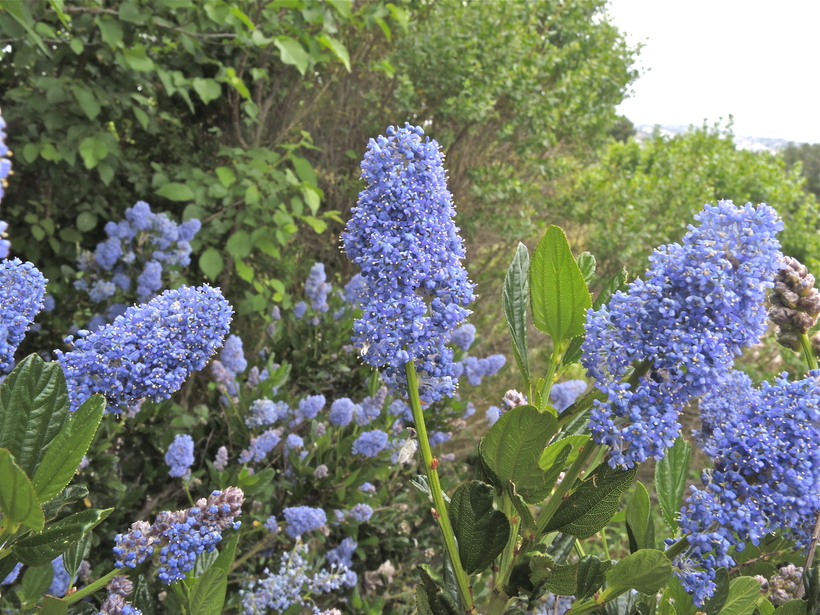
Blueblossom ceanothus (Ceanothus thyrsiflorus) is a large shrub or small tree in the Buckthorn family (Rhamnaceae). Evergreen, glossy leaves range from bright green to dark green. Small flower clusters range in color from light blue, dark blue, or blue-violet; occasionally a specimen with pale blue-white flowers can be found. Varying dramatically in form and size over its natural range, some plants grow fairly upright to 30 feet and others grow in a mounding form to only 2-3 feet tall. Flowers appear in late winter or early spring, and are an important early source of food for pollinators. Bees are especially attracted to the flowers. Three-lobed seed capsules are eaten by birds and small mammals.
Blueblossom grows primarily along the coast and coastal mountains, in many different habitats, in full sun or part shade. In the hotter, inland part of its range, it can be found growing in the shade of northern slopes, under mature woodland canopies, or closer to an irrigated or a naturally moist area. In the cooler, coastal areas, it prefers more sun and dry locations.
In the garden, if you continue to provide summer irrigation after it is established, ceanothus species will usually be short-lived. Choose a ceanothus which is native to your location, then stop irrigating after year two or three. Blueblossom can be used alone as a backdrop to shorter shrubs and perennials, or as an evergreen hedge. Prune it to one trunk for a treeform, or keep it natural for a large shrub. When in bloom, blueblossom is almost entirely covered in flowers, creating a dreamy blue haze in the landscape. There are many cultivars available at nurseries all over the state.
Shrub
2 - 30 ft Tall
2 - 40 ft Wide
Mounding, Spreading, Upright Columnar, Weeping
Fast, Moderate
Evergreen
Pleasant, Slight

Blue, White
Winter, Spring
Groundcover, Hedge
Partial Shade
Low
Max 1x / month once established
Moderate
Tolerates cold to 15° F
Fast, Medium, Slow
Reported to tolerate clay and sand, but Ceanothus generally do best in well-drained soil. Do not fertilize or amend.
Soil PH: 5.0 - 7.0
Tip pruning helps maintain a compact shape. Larger shrubs benefit from removal of leafless interior branches to open up structure and encourage new growth. Pruning is best done in dry season to prevent infection.
For propagating by seed: Hot water and 2-3 mos. stratification.
6, 7, 8, 9, 14*, 15*, 16*, 17*, 19, 20*, 21*, 22*, 23*, 24*
Chaparral, redwood forest, and mixed woodland slopes and canyons below 2, 000 ft. primarily along the coast and foothills of the Coast Ranges from Del Norte County to Monterey County, with scattered locations south and inland
Chaparral, Mixed Evergreen Forest, Northern Coastal Scrub, Redwood Forest
Flannelbush (Fremontodendron spp.), Bush Poppy (Dendromecon rigida), Manzanitas (Arctostaphylos spp.), Coast Buckwheat (Eriogonum latifolium), Golden Yarrow (Eriophyllum confertiflorum), Sticky Monkeyflower (Diplacus aurantiacus), and various Rhus and Ribes species
Butterflies and moths supported
14 confirmed and 79 likely
Orange Tortrix Moth
Argyrotaenia franciscana