

Carried by 43 nurseries
View Availability at NurseryData provided by the participants of the Consortium of California Herbaria
View additional distribution information on the Jepson eflora
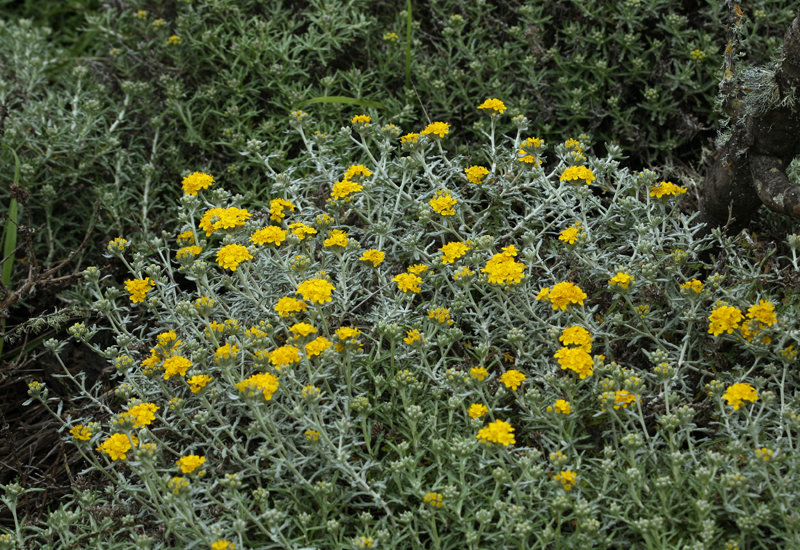
Golden yarrow (Eriophyllum confertiflorum) is a flowering plant in the daisy family that is highly variable and can be an annual, a perennial or a small shrub. Golden yarrow is part of a number of plant communities, including chaparral, coastal sage shrub, and southern oak woodland.
It grows in large clumps of many erect stems, often as high as 2 feet high and 2 feet wide. It has lacy silver foliage. At the top of each stem is a flower cluster of up to 30 flower heads, each bright golden yellow. The long blooming season from winter to summer makes this plant welcome in the garden. Cutting the dead flower heads extends the bloom.
IT is not to be confused with Yellow Achillea which is a European import. Golden yarrow is very attractive to pollinators, especially butterflies.
Golden yarrow is a fast growing plant that takes full sun and well-draining soil. It needs very little water, a maximum of two times per month in summer once established.
Shrub, Annual herb, Perennial herb
2 ft Tall
2 ft Wide
Upright Columnar
Moderate
Summer Semi-deciduous, Winter Deciduous

Yellow
Summer, Spring, Winter
Deer resistant
Full Sun
Very Low, Low
Max 2x / month once established
Moderate
Tolerates cold to 5° F
Medium, Slow
Tolerates clay soil.
Tolerates sodic soil..
Soil PH: 5.0 - 8.0
Deadhead to extend blooming
By seeds or cuttings
Openings in woodlands or shrublands, in a variety of settings from coastal bluffs to inland hills and canyons
Chaparral, Foothill Woodland, Lodgepole Forest, Red Fir Forest, Subalpine Forest, Valley Grassland, Yellow Pine Forest
Purple Sage (Salvia leucophylla), Sticky Monkeyflower (Diplacus aurantiacus), California Sagebrush (Artemisia californica), Deerweed (Acmispon glaber), Brittlebush (Encelia spp.), Sage (Salvia spp.), Manzanita (Arctostaphylos spp.), Oaks (Quercus spp.), Lodgepole Pine (Pinus contorta), Ponderosa Pine (Pinus ponderosa), Red Fir (Abies magnifica), Ceanothus species, Yucca species, native grasses, and Dudleya species
Butterflies and moths supported
1 confirmed and 6 likely
Geranium Plume Moth
Amblyptilia pica
Orange Tortrix Moth
Argyrotaenia franciscana