

Carried by 14 nurseries
View Availability at NurseryData provided by the participants of the Consortium of California Herbaria
View additional distribution information on the Jepson eflora
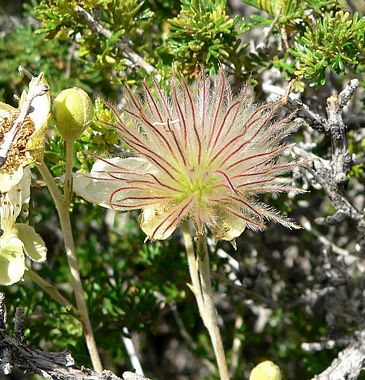
Fallugia is a monotypic genus of shrub in the Rosaceae (Rose) family, containing the single species Fallugia paradoxa, which is known by the common names Apache Plume and Ponil. This plant is native to the southwestern United States and northern Mexico, where it is found in arid habitats such as desert woodlands and scrub. In California it is restricted to a small area of desert mountains in San Bernardino and Inyou Counties. Apache plume is an erect shrub not exceeding two meters in height. It has light gray or whitish peeling bark on its many thin branches. The leaves are each about a centimeter long and deeply lobed with the edges rolled under. The upper surface of the leaf is green and hairy and the underside is duller in color and scaly. The flower of the shrub is roselike when new, with rounded white petals and a center filled with many thready stamens and pistils. The ovary of the flower remains after the white petals fall away, leaving many plumelike lavender styles, each 3 to 5 centimeters long. The plant may be covered with these dark pinkish clusters of curling, feathery styles after flowering. Each style is attached to a developing fruit, which is a small achene. The fruit is dispersed when the wind catches the styles and blows them away. This plant is considered valuable for erosion control in desert areas where it grows. It is also a good choice for arid and semi-arid gardens.
Shrub
3 - 7 ft Tall
6 ft Wide
Upright
Fast
Summer Semi-deciduous

Purple, Lavender, Pink, White, Green
Spring
Containers, Hedge
Full Sun, Partial Shade
Low, Moderate, Very Low
Max 2x / month once established
Moderate
Tolerates cold to -5° F
Fast
Typically coarse sand or decomposed granite.
Soil PH: 6.0 - 8.0
For propagating by seed: No treatment.
1, 2, 5, 7, 8, 9, 14*, 15*, 16*, 17, 18*, 19*, 20*, 21*, 22*, 23*, 24
Dry, rocky slopes of desert mountains up to 5, 000 ft.
Joshua Tree Woodland, Pinyon-Juniper Woodland
Use with other high desert species such as Joshua Tree (Yucca brevifolia), Pinyon Pine (Pinus edulis or monophylla), Juniper (Juniperus californica or osteosperma), Brittlebush (Encelia actonii or farinosa), Desert Agave (Agave deserti), Desert Lavender (Condea emoryi), and Chia (Salvia columbariae). Also compatible with many chaparral and coastal sage scrub plants.
Butterflies and moths supported
1 confirmed and 0 likely