

Carried by 15 nurseries
View Availability at NurseryData provided by the participants of the Consortium of California Herbaria
View additional distribution information on the Jepson eflora
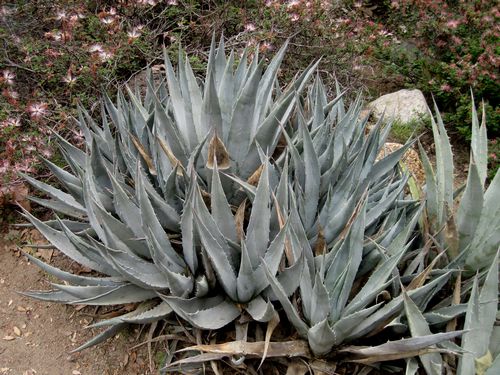
Native to the desert regions of Southern California, Arizona, and Baja California, Desert Agave (Agave deserti) is an iconic plant of the Southwestern landscape. Its low water needs also make it an ideal plant for the waterwise garden.
Desert Agave grows in clusters. The individual plants are rosette-shaped, with long gray-green leaves that have sharp spines at the tips and along the edges. For safety, it is best to plant it away from walkways and other high-traffic areas. Desert Agave is a slow-growing plant. At full maturity, it will send up very tall spikes of yellow flowers. The blooms attract hummingbirds and insects. Individual plants die after blooming, but other plants in the cluster will continue to grow.
Plant Desert Agave in dry, rocky, well-draining soil. It is highly drought adapted, with minimal water needs. It is both heat and cold tolerant, although some species can be sensitive to frost.
Shrub, Succulent
1 - 20 ft Tall
3 ft Wide
Slow
Evergreen

Yellow
Spring, Summer
Deer resistant
Full Sun
Very Low, Low
Max 1x / month once established
Moderate
Tolerates cold to 15° F
Fast
Typically decomposed granite.
Tolerates sodic soil..
Soil PH: 7.0 - 8.0
For propagating by seed: No treatment. Pups can be removed from the base of the mother plant (with caution) and relocated.
3, 7, 8*, 9*, 10*, 11, 12*, 13, 14*, 15, 16, 18, 19*, 20*, 21*, 22, 23
Rocky slopes, canyons, desert washes
Creosote Bush Scrub, Shadscale Scrub
Use in a desert garden with Desert Lavender (Condea emoryi), Desert Willow (Chilopsis linearis), California Fan Palm (Washingtonia filifera), Creosote Bush (Larrea tridentata), Ocotillo (Fouquieria splendens), Jojoba (Simmondsia chinensis), Blue Paloverde (Parkinsonia florida), White Bursage (Ambrosia dumosa), Chuparosa (Justicia californica), Barrel Cactus (Ferocactus cylindraceus), Desert Agave (Agave deserti), Brittlebush (Encelia farinosa), Indigo Bush (Psorothamnus spp.), Smoke Tree (Psorothamnus spinosus), Apricot Mallow (Sphaeralcea ambigua), Opuntia spp., numerous annual wildflowers
Butterflies and moths supported
1 confirmed and 1 likely
California Giant-Skipper
Agathymus stephensi
Mojave Giant-Skipper
Agathymus alliae
Miller, G.O. (2008). Landscaping with Native Plants of Southern California. Voyageur Press