

Carried by 6 nurseries
View Availability at NurseryData provided by the participants of the Consortium of California Herbaria
View additional distribution information on the Jepson eflora
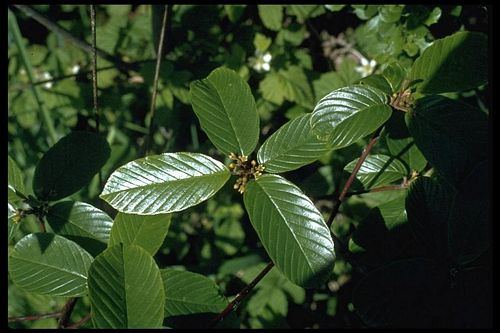
Rhamnus purshiana (Cascara Buckthorn, Cascara, Bearberry, and in the Chinook Jargon, Chittam or Chitticum; syn. Frangula purshiana, Rhamnus purshianus) is a species of buckthorn native to western North America from southern British Columbia south to central California, and inland to western Montana. It is the largest species of buckthorn, occasionally growing up to 15 meter tall, though more commonly a large shrub or small tree 5-10 meter tall, with a trunk 20-50 centimeter in diameter. The bark is brownish to silver-grey with light splotching. The leaves are deciduous, alternate, clustered near the ends of twigs; they are oval, 5-15 centimeter long and 2-5 centimeter broad with a 0.6-2 centimeter petiole, dark shiny green on top, fuzzy and paler green below. The flowers are tiny, 4-5 millimeter diameter, with five greenish yellow petals; the flowering season is brief, disappearing by early summer. The fruit is a berry 6-10 millimeter diameter, bright red at first, quickly maturing deep purple or black, and containing three seeds.
Shrub
20 - 49 ft Tall
12 ft Wide
Upright
Slow
Winter Deciduous

White, Green, Yellow
Spring
Bank stabilization
Partial Shade, Full Sun
Low
Max 3x / month once established
Tolerates cold to 0° F
Fast, Medium, Slow, Standing
Quite adaptable to a wide variety of soil types.
Soil PH: 4 - 7
Propagate from seeds (3 month stratification) or by cuttings taken from half-ripe to mature wood in late summer or fall.
1, 2, 3, 4*, 5*, 6*, 7, 14, 15*, 16*, 17*
Varied, but generally in low-montana forested areas in moist canyons, swamps, and bottomlands.
Chaparral
Other plants of western coniferous forest understories such as Red Alder (Alus Rubra), Vine Maple (Acer circinatum), Redosier Dogwood (Cornus sericea), and Orange Honeysuckle (Lonicera ciliosa).
Butterflies and moths supported
8 confirmed and 27 likely
Tamarack Looper
Eupithecia misturata
Green Pug
Eupithecia ravocostaliata