

Carried by 3 nurseries
View Availability at NurseryData provided by the participants of the Consortium of California Herbaria
View additional distribution information on the Jepson eflora
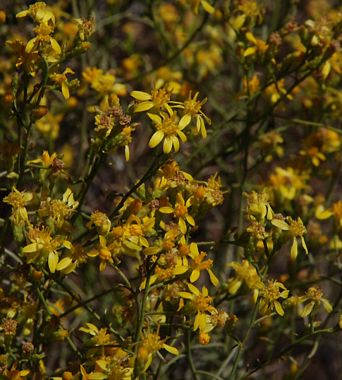
Gutierrezia californica is a species of flowering plant in the Asteraceae (Sunflower) family known by the common names San Joaquin snakeweed and California matchweed. It is native to California and Baja California, where it grows on slopes and plains in a number of habitats. It is found in the Coast Ranges, Transverse Range and Peninsular Range, coming fairly close to the coast in Los Angeles, Orange and San Diego Counties. It is often seen in very arid settings. This is a small subshrub reaching up to about half a meter in height. It grows clumpy or gangly and generally erect stems in shades of gray and red which are lined with small linear green leaves. At the end of each branch of the stem is an flower cluster of one to three small flower heads just a few millimeters wide. The head contains several yellow disc florets with long, protruding styles and several yellow ray florets around the edge.
Shrub, Annual herb, Perennial herb
1 - 2 ft Tall
3 ft Wide
Summer Semi-deciduous

Yellow, Red
Spring, Summer, Fall
Full Sun
Very Low
Max 1x / month once established
Tolerates cold to 15° F
Fast, Medium
Prefers rocky, gravelly or sandy soil, such as decomposed granite.
Soil PH: 6.5 - 7.5
For propagating by seed: No treatment.
7, 8*, 9*, 11, 12, 13, 14*, 15*, 16*, 17, 19*, 20*, 21*, 22*, 23*, 24*
Grassy places, slopes, outcrops below 6, 700 ft.
Chaparral, Oak Woodland, Pinyon-Juniper Woodland, Valley Grassland
May be used with a wide variety of chaparral plants such as Chamise (Adenostema fasciculatum), Big Sagebrush (Artemisia tridentata), Ceanothus spp., Buckwheat (Eriogonum spp.), White Sage (Salvia apiana), Cleveland Sage (Salvia clevelandii), Desert Sage (Salvia dorrii), Rose Sage (Salvia pachyphylla) Antelope Brush (Purshia stansburyana or tridentata), and various cactus and succulents.
Butterflies and moths supported
0 confirmed and 9 likely
Dusky Raisin Moth
Ephestiodes gilvescentella
Green Broomweed Looper Moth
Fernaldella fimetaria