

Carried by 22 nurseries
View Availability at NurseryData provided by the participants of the Consortium of California Herbaria
View additional distribution information on the Jepson eflora
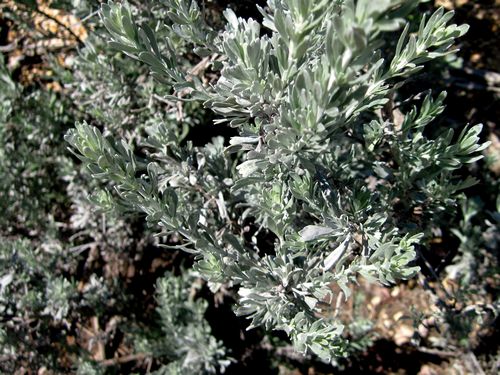
Big Sagebrush (Artemisia tridentata) is a dense, silvery-gray shrub with an upright form, growing up to 4 feet tall and wide. Its highly aromatic foliage lasts year-round, and, unlike other sages, it develops a true woody trunk and branches, making it long-lived. In maturity, the twisted trunk adds unique visual appeal. The flowers, small and yellow-green, are often inconspicuous.
This plant thrives in full sun and well-drained soil, is nitrogen-fixing, and is drought-tolerant. It provides significant wildlife value, attracting a variety of insects, birds, and small mammals with its flowers and seeds.Big Sagebrush (Artemisia tridentata) is a dense, silvery-gray shrub with an upright form, growing up to 4 feet tall and wide. Its highly aromatic foliage lasts year-round, and, unlike other sages, it develops a true woody trunk and branches, making it long-lived. In maturity, the twisted trunk adds unique visual appeal. The flowers, small and yellow-green, are often inconspicuous.
This plant thrives in full sun and well-drained soil, is nitrogen-fixing, and is drought-adapted. It provides significant wildlife value, attracting a variety of insects, birds, and small mammals with its flowers and seeds.
Shrub
3 - 15 ft Tall
10 ft Wide
Upright, Rounded
Moderate, Slow
Evergreen
Pleasant

Yellow, Green, Cream, White
Summer
Bank stabilization, Groundcover, Hedge
Full Sun
Very Low, Low
Max 1x / month once established
Easy
Tolerates cold to -10° F
Fast, Medium
Prefers coarse, well drained soil such as decomposed granite.
Soil PH: 6.0 - 8.5
Stratified seeds or cuttings. For propagating by seed: 3-3.5 mos. stratification (USDA Forest Service 1974); 10 wks. may be sufficient (Stidham et al. 1980).
Dry valleys, canyons and slopes typically on the east slope of mountain ranges
Coastal Sage Scrub, Joshua Tree Woodland, Northern Juniper Woodland, Pinyon-Juniper Woodland, Sagebrush Scrub, Yellow Pine Forest
Greenleaf Manzanita (Arctostaphylos patula), Parry Manzanita (Arctostaphylos parryana), Rubber Rabbitbrush (Ericameria nauseoua), California Juniper (Juniperus californicus), Scarlet Bugler (Penstemon centranthifolius), Showy (Penstemon spectabilis), Jeffrey Pine (Pinus jeffreyi), Oneneedle Pine (Pinus monophylla), Antelope Brush (Purshia tridentata) and Joshua Tree (Yucca brevifolia).
Butterflies and moths supported
3 confirmed and 29 likely
Nevada Tiger Moth
Apantesis nevadensis
Hera Buckmoth
Hemileuca hera
Acute-lined Flower Moth
Schinia acutilinea