

Carried by 73 nurseries
View Availability at NurseryData provided by the participants of the Consortium of California Herbaria
View additional distribution information on the Jepson eflora
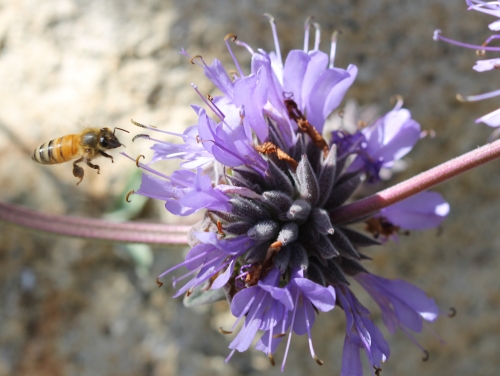
Cleveland sage (Salvia clevelandii) is a small, evergreen shrub in the Mint family (Lamiaceae). The small gray-green leaves are very fragrant, as are the whorls of purple flowers. One shrub can perfume the whole garden on a warm, summer afternoon. Hummingbirds adore the nectar from the tubular flowers. It also attracts butterflies, bees, moths, and other pollinators. This is an important food source during the heat of summer.
It is native to chaparral and coastal sage scrub in Southern California, where it survives on annual rainfall alone. Plant Cleveland sage on well-drained flats, bluffs or gentle slopes for best results. Limit summer water to no more than once per month; although, no irrigation in summer after a year or two is best. This sage is arguably one of the most fragrant. Several cultivars and hybrids that are often available in nurseries are 'Winnifred Gilman', 'Allen Chickering', 'Aromas', 'Pozo Blue', and 'Whirly Blue', and 'Celestial Blue'.
Shrub
3 - 4 ft Tall
8 ft Wide
Mounding
Fast, Moderate
Evergreen
Pleasant

Blue, Purple, Lavender
Spring, Summer
Bank stabilization, Deer resistant
Partial Shade, Full Sun
Very Low
Never irrigate once established
Easy
Tolerates cold to 20° F
Medium
Tolerant of a variety of soils, although performs better in well-drained soils.
Soil PH: 6.0 - 8.0
May be deadheaded to extend blooming season. May be pruned in fall to reduce size.
For propagating by seed: No treatment; sow outdoors in early fall. Germination may be poor if diurnal fluctuation is insufficient; also see alternative treatments for Black Sage (Salvia mellifera).
7, 8, 9, 14*, 15*, 16*, 17*, 18, 19*, 20*, 21*, 22*, 23*, 24*
Coastal to inland hills, canyons, bluffs and mesas as a component of mixed chaparral or coastal sage scrub
Chaparral, Coastal Scrub
Chamise (Adenostoma fasciculatum var. fasciculatum), Woolly Bluecurls (Trichostema lanatum), White Sage (Salvia apiana), California Buckwheat (Eriogonum fasciculatum var. fasciculatum), California Coffeeberry (Frangula californica ssp. californica), Toyon (Heteromeles arbutifolia), Lemonade Berry (Rhus integrifolia), Coastal Prickly Pear Cactus, Manzanita species, Yucca species.
Butterflies and moths supported
2 confirmed and 6 likely
California Pyrausta Moth
Pyrausta californicalis
Volupial Pyrausta Moth
Pyrausta volupialis
Alfalfa Looper Moth
Autographa californica