

Carried by 14 nurseries
View Availability at NurseryData provided by the participants of the Consortium of California Herbaria
View additional distribution information on the Jepson eflora
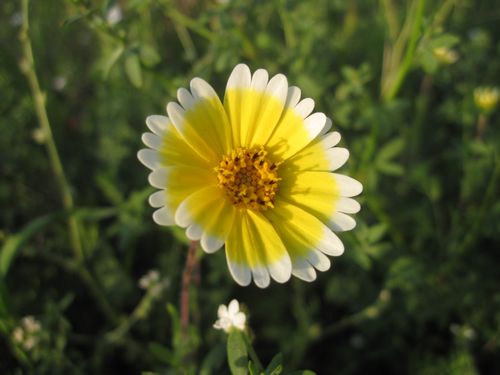
Common Tidy Tips (Layia platyglossa) is an annual wildflower in the Asteraceae (Sunflower) family. Like other members of this family, it has composite flower heads. Its 5 to 18 outer ray flowers are bright golden yellow with distinct, sharp-margined white tips. The inner disk flowers are numerous and yellow-orange. The entire flower head is 2 inches in diameter.
It is native to California's low-elevation dry habitats in the Coast Ranges, Central Valley, Channel Islands, and southern coastal plain where it is a member of spring wildflower displays in meadows and grasslands. It is found in many different habitats.
Its daisy-like flowers are attractive, making it a popular garden ornamental and ingredient in commercial wildflower seed mixes. It is especially attractive when massed and combined with other wildflowers. It seems to like somewhat more water than some other wildflowers but works well with many other plants.
Annual herb
6 - 24 in Tall
6 - 24 in Wide

Yellow
Spring, Winter
Containers
Full Sun
Low
Max 3x / month once established
Moderate
Tolerates cold to -5° F
Fast, Medium, Slow
Prefers clay or loamy soil, tolerates sandy soil.
Soil PH: 5.0 - 8.0
By seed
1, 2, 3, 4, 5, 6, 7*, 8*, 9*, 14*, 15*, 16*, 17*, 18*, 19*, 20*, 21*, 22*, 23*, 24
Meadows
Chaparral, Foothill Woodland, Northern Coastal Scrub, Valley Grassland, Yellow Pine Forest
Use in a grassland or meadow-like garden with other annuals or herbaceous perennials such as California Poppy (Eschscholzia californica), Clarkia spp., Lupinus spp., Baby Blue Eyes (Nemophila menziesii) and Sidalcea spp.; with geophytes such as Brodiaea spp., Mariposa Lily (Calochortus spp.), and Blue Dicks (Dipterostemon capitatus); and with succulents such as Dudleya spp. and various cactus species.
Butterflies and moths supported
0 confirmed and 1 likely
Small Heliothodes Moth
Heliothodes diminutivus