

Carried by 3 nurseries
View Availability at NurseryData provided by the participants of the Consortium of California Herbaria
View additional distribution information on the Jepson eflora
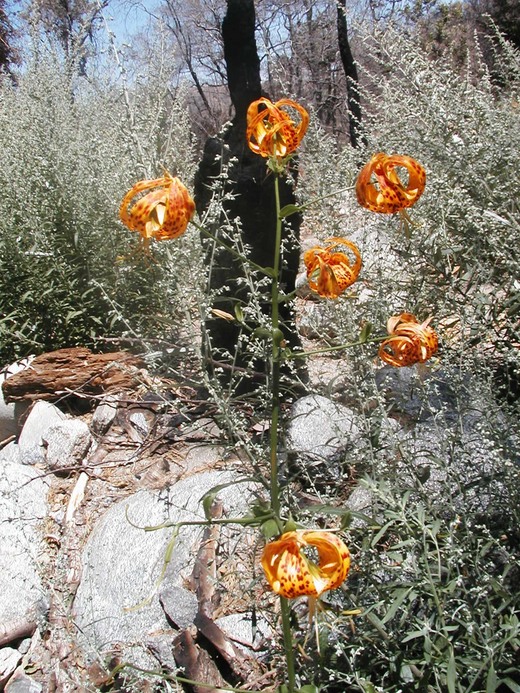
Spotted Humboldt's Lily is one of two recognized subspecies of Lilium humboldtii. This is a rare native perennial herb that grows from Santa Barbara County to San Diego County, on some of the Channel Islands, and in northern Baja. Due to its limited distribution it is included on CNPS list 4.2. This subspecies was previously known as L.h. ssp. bloomerianum, and some sources may still refer to it by that name. It tends to grow in dry shade at elevations from near sea level to 5,500 feet. The large and showy flowers are golden-orange with dark red or maroon splotches and orange to brown stamens. The plant flowers in June, with flowers growing in a pyramidal flower cluster. The flowers are on stout stems, which are sometimes brown-purple. The subrhizomatous bulb is large, with yellowish-white scales, and grows very deep in the soil. The leaves grow in whorls, and are undulate, shiny, and oblance-shaped. It is summer-deciduous, dying back after flowering in mid- to late summer, and it should be allowed to go dry at that time. In winter it will do well with minimal supplemental water unless it is an especially dry winter.
Perennial herb, Geophyte
6 - 8 ft Tall
1 - 2 ft Wide
Upright Columnar
Fast, Moderate
Summer Deciduous

Brown, Orange, Purple, Red, Yellow
Spring, Summer
Full Sun, Partial Shade
Low, Moderate, Very Low
Never irrigate once established
Moderate
Tolerates cold to 25° F
Fast
Prefers well draining, slightly acidic soil.
Soil PH: 5.0 - 7.0
May be cut back to the ground in late summer after it has gone completely dormant
7*, 14, 15, 16, 17, 18, 19, 20, 21, 22, 23, 24
Shaded woodland canyons in southern California, openings in chaparral, woodland or pine forest
Chaparral, Foothill Woodland, Yellow Pine Forest
Use in the understory of trees and large shrubs of the south Coast Ranges or Channel Islands, such as Oaks (Quercus spp.), Pines (Pinus spp.), Santa Cruz Island Ironwood (Lyonothamnus floribundus ssp. aspleniifolius), Toyon (Heteromeles arbutifolia), Summer Holly (Comarostaphylis diversifolia ssp. diversifolia), Manzanita (Arctostaphylos spp.), Ceanothus spp., and Holly-leafed Cherry (Prunus ilicifolia).
Butterflies and moths supported
0 confirmed and 1 likely
Reaper Dart
Euxoa messoria