

Carried by 9 nurseries
View Availability at NurseryData provided by the participants of the Consortium of California Herbaria
View additional distribution information on the Jepson eflora
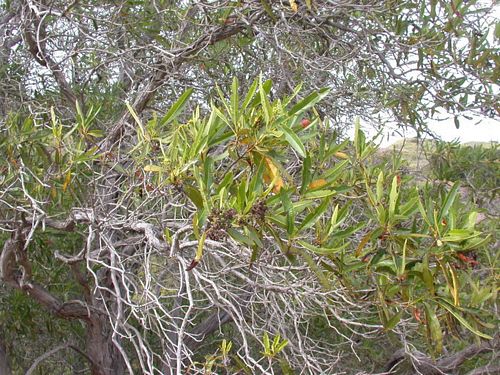
Island Ironwood (Lyonothamnus floribundus) is a native tree that grows in Southern and Central California, primarily in the Channel Islands region. It tends to grow in rocky slopes, at elevations from 100-1600 feet. Lyonothamnus is endemic to the Channel Islands of California, where it grows in the chaparral and oak woodlands of the rocky coastal canyons.
This is a tree growing up to 15 metres (49 ft) tall with peeling reddish gray or brown bark. The evergreen leaves are shiny, dark green with lighter undersides, and borne on short petioles. The two subspecies have leaves of different leaf shapes. Ssp. asplenifolius (Santa Cruz Island Ironwood) has incised, fern-like leaves and is the more commonly available in horticultural form. Ssp. floribundus (Catalina Island Ironwood) has smooth, undivided leaves and is seldom seen in gardens. The inflorescence of both is a cluster of woolly white flowers with many short, whiskery stamens. The fruit is a pair of hard follicles.
Tree
25 - 50 ft Tall
15 - 24 ft Wide
Upright Columnar
Fast
Evergreen
None

Cream, White
Spring, Summer
Bank stabilization, Hedge
Full Sun
Low
Max 1x / month once established
Tolerates cold to 22° F
Fast, Medium
This tree is tolerant of a variety of garden soils as long as drainage is reasonably good.
Soil PH: 5.0 - 8.0
For propagating by seed: Place seeds in about 6 times their volume of 140°F wa ter then let cool about 45 mins. before sowing ( Maunsell Van Rensselaer correspondence to Howard McMinn 1947). No treatment. gives fair germination.
Rocky slopes
Chaparral
Use with other island species such as Catalina Island Manzanita (Arctostaphylos catalinae), Santa Cruz Island Buckwheat (Eriogonum arborescens), St. Catherine's Lace (Eriogonum giganteum), Redflower Bucksheat (Eriogonum grande var. rubescens), Tree Poppy (Dendromecon harfordii), Giant Coreopsis (Leptosyne gigantea), Catalina Cherry (Prunus ilicifolia ssp. lyonii), Island Hazardia (Hazardia cana) and Island Bristleweed (Hazardia dentonsa)
Butterflies and moths supported
1 confirmed and 0 likely
Western Avocado Leafroller Moth
Amorbia cuneana