

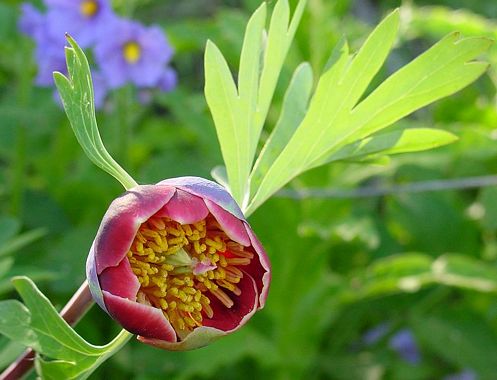
Carried by 3 nurseries
View Availability at NurseryData provided by the participants of the Consortium of California Herbaria
View additional distribution information on the Jepson eflora
Paeonia californica (California Peony or Wild Peony) is one of two species of Peony native to North America. It is endemic to southwest California, United States, where it grows on dry hillsides in the coastal sage scrub and chaparral communities of the coastal mountains of Southern and Central California, on the coastal slope of the mountains, from Monterey County southward. It is often seen as an understory plant among chaparral shrubs. Some authorities consider it a subspecies of Paeonia brownii which is found in the northern Sierra and Klamath mountains. It is not a rare species in the wild, but uncommon in gardens because it is very particular about conditions. It needs a dry summer dormancy, and normal garden watering will kill it.
Perennial herb
2 ft Tall
Summer Deciduous

Purple, Red
Winter, Spring
Deer resistant
Partial Shade, Full Sun
Moderate
Never irrigate once established
Tolerates cold to -5° F
Fast, Medium, Slow
Tolerates a variety of soils, including clay, coarse sand, decomposed granite, and serpentine.
Tolerates serpentine soil..
Soil PH: 6.0 - 8.0
This plant grows from a rootstock that can be difficult to transplant. Seed is said to be a more reliable but slower method of establishing the plant in the garden.
7*, 9, 14*, 15*, 16*, 17*, 18, 19, 20, 21, 22, 23, 24
Coastal plains, foothills, canyons and mountains with dry summers
Chaparral, Coastal Sage Scrub
Use with other chaparral and sage scrub species that tolerate dry summer conditions, such as Eastwood Manzanita (Artcostaphylos glandulosa), Ceanothus spp., Flannelbush (Fremontodendron spp.), Buckwheat (Eriogonum spp.), California Fuchsia (Epilobium canum), Scrub Oak (Quercus berberidifolia or dumosa), Woolly Bluecurls (Trichostema lanatum), succulents such as Dudleya spp. and various cactus species.