

Carried by 2 nurseries
View Availability at NurseryData provided by the participants of the Consortium of California Herbaria
View additional distribution information on the Jepson eflora
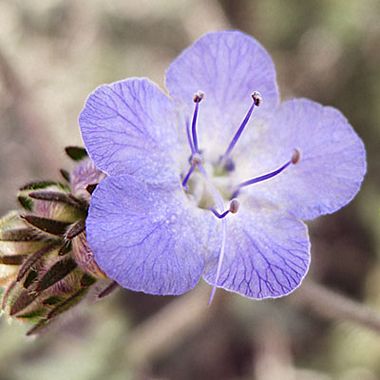
Phacelia distans is a species in the Boraginaceae (Borage) family known by the common name distant phacelia. It is native to much of California including the coastal mountain ranges, valleys, and deserts, adjacent sections of Nevada and Arizona, and parts of northern Mexico. It grows in many types of habitats and is a common wildflower in its range. It is a variable annual herb growing decumbent to erect, its branching or unbranched stem 15 to 80 centimeters in length. It is usually coated in soft or stiff glandular hairs which some people find foul-smelling when touched. The leaves are up to 10 to 15 centimeters long and are divided into several lobed leaflets, sometimes intricately. The hairy flower cluster is a one-sided curving or coiling cyme of many funnel- or bell-shaped flowers. The flower is just under a centimeter long and is usually blue but may be white or varying shades of lavender or purple. It is most often used in a wildflower garden where it is grown from seed. Under suitable conditions it will re-seed itself. As with all annuals, careful weeding is essential.
It should be noted that there are a very large number of species in the genus Phacelia. Most are annuals. Gardeners should look for species appropriate to their area and garden conditions.
Annual herb
2 - 31 in Tall
3 ft Wide
Fast
Unpleasant

Purple, Lavender
Spring
Containers
Full Sun
Very Low
Never irrigate once established
Moderate
Tolerates cold to 5° F
Fast, Medium
Tolerates a variety of soils as long as drainage is good.
Soil PH: 5.5 - 8.0
By seed
3, 7*, 8*, 9*, 10, 11*, 12*, 13*, 14*, 15*, 16*, 17*, 18*, 19*, 20*, 21*, 22*, 23*, 24*
Clay or rocky slopes
Chaparral, Foothill Woodland, Lodgepole Forest, Red Fir Forest, Valley Grassland, Yellow Pine Forest
Use with regionally appropriate annual wildflowers and perennial shrubs including Manzanita (Arctostaphylos spp.), Ceanothus spp., California Poppy (Eschscholzia californica), Ocotillo (Fouquieria splendens), Creosote Bush (Larrea tridentata), Lupine (Lupinus spp.), Joshua Tree (Yucca brevifolia), and a variety of cactus and succulent speciess
Butterflies and moths supported
3 confirmed and 6 likely
Oso Flaco Flightless Moth
Areniscythris brachypteris
Geranium Plume Moth
Amblyptilia pica