

Carried by 36 nurseries
View Availability at NurseryData provided by the participants of the Consortium of California Herbaria
View additional distribution information on the Jepson eflora
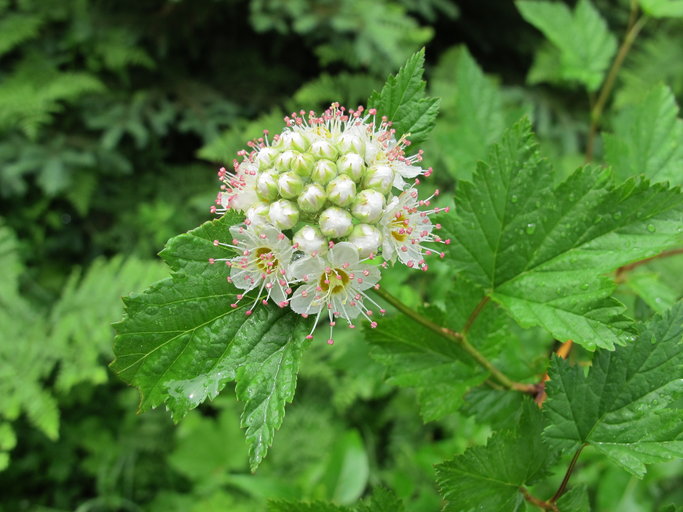
Physocarpus capitatus (Pacific Ninebark) is a species in the Rosaceae (Rose) family native to western North America from southern Alaska east to Montana and Utah, and south to central California. It is found in the Coast Ranges and the Sierras. It is a dense deciduous shrub growing to 1 to 2.5 meters tall. The name comes from the appearance of the bark, which is flaky, peeling away in many layers. The shrub has distinctive maple-like lobed leaves 3-14 centimeter long and broad, and ball-like clusters of small white flowers with five petals and numerous red-tipped stamens. The unique fruit is an inflated glossy red pod which turns dry and brown and then splits open to release seeds. It is most often found near streams in association with wetland-riparian vegetation. Near the coast and at higher elevations it can take full sun. At lower elevation inland locations it benefits from part shade and moisture. It's leaves change color in fall before dropping. The extensive root system is useful for retaining soil on slopes. It makes a very attractive shrub or small tree for central to northern California gardens.
Shrub
3 - 8 ft Tall
8 ft Wide
Rounded
Moderate, Fast
Winter Deciduous

White, Red
Spring
Hedge
Deep Shade, Partial Shade
Low, Moderate
Max 1x / month once established
Easy
Tolerates cold to 5° F
Medium
Tolerates a variety of soils as long as adequate moisture is present.
Tolerates serpentine soil..
Soil PH: 5.0 - 7.0
Can be pruned after leaves drop to achieve more upright habit and encourage vigorous leaf production in spring
For propagating by seed: No treatment. gives poor germination; 2-3 mos. stratification may improve germination. Easily propagated from stem cuttings.
1, 2, 4*, 5*, 6*, 7*, 8, 9, 14*, 15*, 16*, 17*, 18*, 19*, 20*, 21*, 22*, 23*, 24*
Moist banks and north facing slopes, usually in wetland-riparian community, often in mixed woodland or forest, usually below 5, 000 ft.
Chaparral, Red Fir Forest, Forest, Yellow Pine Forest, Wetland-Riparian
Can be used with a wide variety of woodland and northern chaparral plants including Firs (Abies spp.), Pipevine (Aristolochia californica), Dogwood (Cornus spp.), Silk Tassel Bush (Garrya spp.), Douglas Fir (Pseudotsuga menziesii), Ponderosa Pine (Pinus ponderosa), Sycamore (Platanus racemosa), Cottonwoods (Populus spp.), Chokecherry (Prunus virginiana), Currant/Gooseberry (Ribes spp.), and Coast Redwood (Sequoia sempervirens)
Butterflies and moths supported
1 confirmed and 7 likely
Oblique-Banded Leafroller Moth
Choristoneura rosaceana
Northwestern Phoenix Moth
Eulithis xylina
Common Eupithacia
Eupithecia miserulata