

Carried by 14 nurseries
View Availability at NurseryData provided by the participants of the Consortium of California Herbaria
View additional distribution information on the Jepson eflora
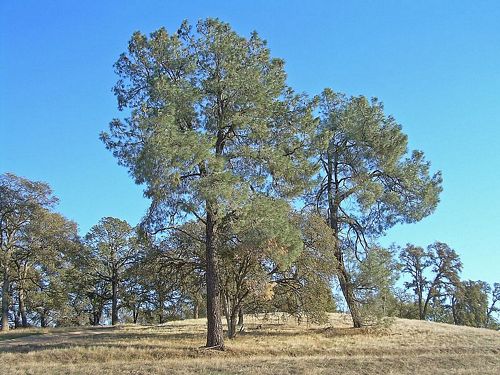
Foothill Pine (Pinus sabiniana), also known as gray or ghost pine, is a slow-growing and moderately long-lived tree native to California. It grows at elevations up to 4,500 feet and has distinct, long, drooping, silvery-green foliage. The yellow flowers bloom in early spring, and the tree bears sweet edible seeds. This pine is quite resilient, thriving in areas with poor soils and dry conditions.
Foothill Pine grows in an upright form to a height of up to 80 feet, but with regular irrigation, it can reach 40-60 feet in landscaping applications. Its feathery, lacey canopy allows plenty of light to filter through, making it an excellent choice for planting understory plants beneath it without much interference. This tree is perfect for dry, challenging areas and provides a soft, dappled shade.
Tree
20 - 80 ft Tall
20 - 40 ft Wide
Upright, Pyramidal, Upright Columnar
Fast, Slow
Evergreen
Pleasant

Yellow
Spring, Winter
Bank stabilization, Hedge
Full Sun, Partial Shade
Very Low, Low
Max 1x / month once established
Easy
Tolerates cold to -20 - -10° F
Fast, Medium
Poor soils, serpentine soils.
Tolerates serpentine soil..
Soil PH: 5 - 8
Fine to prune off bottom branches. Prune in winter when wood boring insects are less active.
For propagating by seed: 2-4 mos. stratification; for small lots, cracking seed coats first gives quicker germination ( USDA Forest Service 1974).
3, 4*, 5*, 6*, 7*, 8, 9, 10, 11, 14*, 15*, 16*, 17*, 18*, 19*, 20*, 21*, 22*, 23*, 24*
places with poor soils
Foothill Woodland
Blue Oak (Quercus douglasii), Pacific Sanicle (Sanicula crassicaulis), California Bedstraw (Galium californicum ssp. flaccidum), Phlox Leaved Bedstraw (Galium andrewsii), Coast Live Oak (Quercus agrifolia), Valley Oak (Quercus lobata), Common Yarrow (Achillea millefolium), Hollyleaf Redberry (Rhamnus ilicifolia)
Butterflies and moths supported
3 confirmed and 92 likely
Monterey Pine Shoot Moth
Exoteleia burkei
Common Gray
Anavitrinella pampinaria