

Carried by 35 nurseries
View Availability at NurseryData provided by the participants of the Consortium of California Herbaria
View additional distribution information on the Jepson eflora
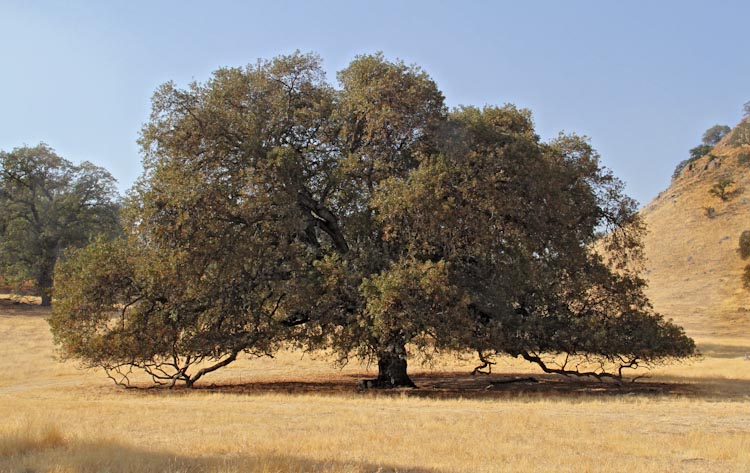
The majestic blue oak is a drought-tolerant deciduous tree that provides food and shelter for local wildlife. It supports birds, squirrels and insects. It is a host plant for several species of butterflies and moths.
This tree gets its name from its blue-green leaves. The bark is pale gray and textured. Blue oaks are slow-growing, but can grow to 80+ feet in height. The canopy can spread to a width of 30 feet or more. It requires a good-sized planting area and does best on dry, well-drained slopes.
Tree
16 - 82 ft Tall
30 ft Wide
Upright, Rounded, Upright Columnar
Slow
Summer Semi-deciduous, Winter Deciduous
None

Yellow, Cream, Green
Spring, Winter
Bank stabilization, Deer resistant
Full Sun, Partial Shade
Low, Very Low
Max 1x / month once established
Easy
Tolerates cold to 0° F
Fast
Tolerant of a variety of soils as long as adequate drainage is provided.
Soil PH: 6.0 - 8.0
Young trees should be pruned for desired shape
From acorns, although hybridization is common.For propagating by seed: Fresh seeds sow in fall outdoors or stratify to hold for spring sowing. If started indoors or in glasshouse, stratify first for 1.5 mos. (USDA Forest Service 1974).
1, 2, 3, 4, 5, 6, 7*, 8, 9*, 10, 11, 14*, 15*, 16*, 17, 18*, 19*, 20*, 21*, 22, 23, 24
Rocky, hot, dry hillsides and slopes usually below 3, 500 ft. in the Coast Ranges and foothills of the Sierra, often in large stands of Blue Oak Woodland or Blue Oak Savannah.
Chaparral, Foothill Woodland, Oak Woodland, Woodland
Coffeeberry (Rhamnus spp.), Buckbrush (Ceanothus cuneatus), Chaparral Whitethorn (Ceanothus leucodermis), Big Berry Manzanita (Arctostaphylos glauca), Buckeye (Aesculus californica), Mountain Mahogany (Cercocarpus betuloides), other oaks (Quercus spp.), pines (Pinus spp.), and native grasses.
Butterflies and moths supported
11 confirmed and 159 likely
Fruit-Tree Leafroller Moth
Archips argyrospila
SelecTree: A Tree Selection Guide. (n.d.). Selectree.calpoly.edu. Retrieved October 18, 2023, from https://selectree.calpoly.edu/tree-detail/1234