

Carried by 23 nurseries
View Availability at NurseryData provided by the participants of the Consortium of California Herbaria
View additional distribution information on the Jepson eflora
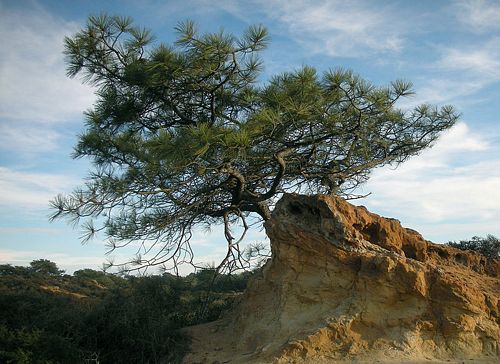
The Torrey pine (Pinus torreyana) is the rarest pine in the U.S., found only along San Diego's coast and on two Channel Islands. This endangered tree grows 26–56 feet tall with long, gray-green needles in clusters of five and large, edible pine nuts in stout cones. It thrives in dry, sandy soils and coastal fog, often developing twisted, sculptural forms from wind exposure.
The pine nuts are a valuable food source for birds, small mammals, and other wildlife. Its dense canopy also provides nesting and shelter for birds.
Historically limited to about 100 trees in the early 20th century, conservation efforts have helped the wild population recover to around 3,000. Torrey pines are now planted in drought-tolerant landscapes and protected by local ordinances near their native range. In gardens with richer soil and more water, they can grow over 100 feet tall.
Tree
25 - 150 ft Tall
25 - 50 ft Wide
Mounding, Pyramidal, Rounded, Spreading, Upright Columnar
Fast, Moderate, Slow
Evergreen
Pleasant

Red, Yellow
Bank stabilization
Full Sun
Low, Moderate
Max 1x / month once established
Moderate
Tolerates cold to -5 - 5° F
Fast, Medium
Sandy soils, sandstone.
Soil PH: 8 - 10
Prune in winter when wood boring insects are less active.
For propagating by seed: 1-3 mos. stratification ( USDA Forest Service 1974).
Sandy bluffs, sandstone cliffs
Chaparral, Coastal Sage Scrub
Toyon (Heteromeles arbutifolia), White Coast Ceanothus (Ceanothus verrucosus), Del Mar Manzanita (Arctostaphylos glandulosa ssp. crassifolia), Lemondade Sumac
Butterflies and moths supported
1 confirmed and 20 likely
Polyphemus moth
Antheraea polyphemus
Orange Tortrix Moth
Argyrotaenia franciscana