

Carried by 3 nurseries
View Availability at NurseryData provided by the participants of the Consortium of California Herbaria
View additional distribution information on the Jepson eflora
This is one of two recognized varieties of Chaparral Currant (Ribes malvaceum). The other is var. viridifolium. Both are known by the same common name. Their ranges are somewhat different but overlapping. Var. Malvaceum is found primarily in the central Coast Ranges from Tehama County to Orange County. Var. viridifolium is found along the coast from Santa Barbara County to San Diego County and northern Baja. For further details see the entry for Ribes malvaceum.
Ribes malvaceum (Montara Rose), Chaparral Currant
Description
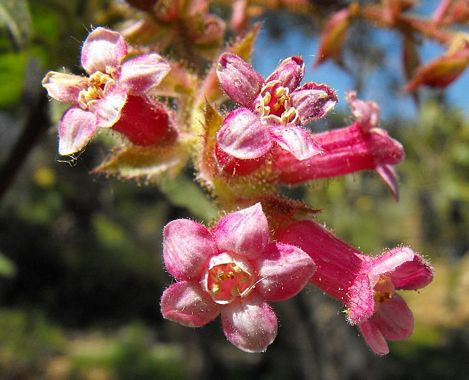
Ribes malvaceum, called "chaparral currant", is a member of the gooseberry family. It is endemic to California. This selection from Montara Mountain grows 4 to 6 ft. tall and has deep pink flowers clusters in the spring that produce edible purple berries. It can handle part shade to full sun, and is one of the earliest ribes to start blooming -- often in late winter. Popular with hummingbirds.
Plant type
Shrub
Size
3 - 5 ft Tall
3 - 5 ft Wide
Form
Spreading
Growth rate
Fast
Dormancy
Summer Deciduous, Winter Deciduous
Fragrance
Pleasant

Color
Pink, White
Sun
Partial Shade
Water
Low, Very Low
Summer irrigation
Max 2x / month once established
Ease of care
Moderate
Cold tolerance
Tolerates cold to 34 - 96° F
Soil drainage
Fast, Medium
Soil description
Medium and coarse, dry.
Soil PH: 5.8 - 8.2
Maintenance
Prune during dry season or after fruiting. Avoid cutting into old wood.
Sunset Zones
6, 7*, 8, 9, 14*, 15*, 16*, 17*, 18*, 19*, 20*, 21*, 22*, 23*, 24*
Site type
Oak woodlands, closed cone pine forests, chaparral
Plant communities
Chaparral, Closed-cone Pine Forest, Foothill Woodland, Oak Woodland
Use with Manzanita (Arctostaphylos spp.), Mountain Mahogany (Cercocarpus betuloides), Bleeding Heart (Dicentra formosa), Yerba Santa (Eriodictyon californicum), Sticky Monkeyflower (Diplacus aurantiacus), California Buttercup (Ranunculus californicus), Hummingbird sage (Salvia spathacea), and various annual herbs such as poppies (Papaver spp.) and Baby Blue Eyes (Nemophila menziesii).
Butterflies and moths supported
0 confirmed and 69 likely
Confirmed
Likely
Milbert's Tortoiseshell
Aglais milberti
Western Avocado Leafroller Moth
Amorbia cuneana
Common names:
Visit About Us for general information about our data sources and terms of use.