

Carried by 59 nurseries
View Availability at NurseryData provided by the participants of the Consortium of California Herbaria
View additional distribution information on the Jepson eflora
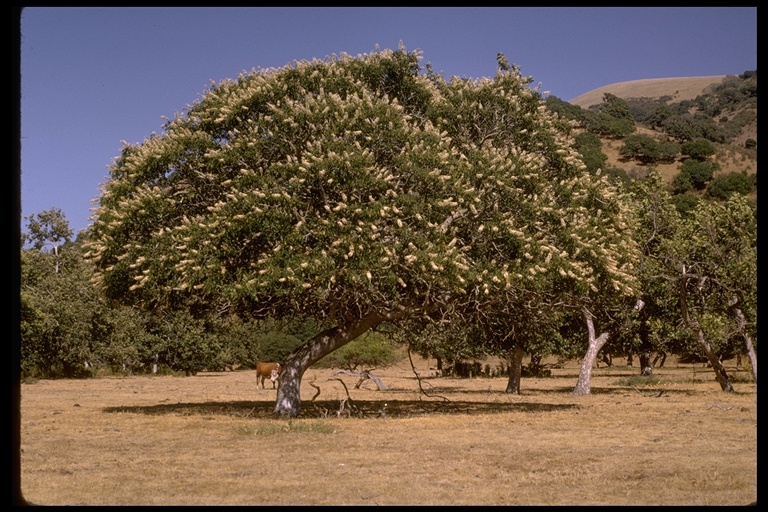
California Buckeye (also known as California Horse-chestnut) is a large shrub or small tree. It is typically multi-trunked and spreads out, with a crown as broad as it is high. California Buckeye is a species in the Sapindaceae family that is endemic to California; it is the only buckeye native to the state.
California Buckeye has gray bark that is often coated with lichens or mosses. It has dark green leaves that can be prone to damage from both spring freezing or snow and summer heat. It tends to leaf out in early spring, followed by creamy-white to pale pink-flower spikes. Some say the flowers resemble candles from afar and butterflies love them!
It has large, shiny round nut-like fruit that appear in late summer and drop in late fall to early winter. Be careful when using this plant in the garden, because all parts of the fruits are toxic.
This plant is very drought tolerant and does well on dry slopes, but looks better with some water. Native (white-flowered) varieties seem to have lower water requirements and are tolerant of recycled water.
Tree
13 - 39 ft Tall
40 ft Wide
Upright, Rounded
Moderate
Summer Deciduous, Winter Deciduous

White, Cream
Summer, Spring
Hedge
Partial Shade, Full Sun
Low, Very Low
Max 2x / month once established
Easy
Tolerates cold to -5° F
Medium, Slow
Tolerates a variety of soils including clay.
Tolerates serpentine soil..
Soil PH: 4.0 - 8.0
For propagating by seed: No treatment; use fresh seeds.
3, 4, 5, 6, 7*, 8*, 9*, 10, 14*, 15*, 16*, 17*, 18*, 19*, 20*, 21*, 22*, 23*, 24*
Dry slopes, canyons or stream edges, most often in the Coast Ranges or Sierra foothills.
Foothill Woodland
Western Serviceberry (Amelanchier pallida or utahensis), Manzanita (Arctostaphylos spp.), Milkweed (Asclepias spp.), Spicebush (Calycanthus occidentalis), Ceanothus spp., Larkspur (Delphinium spp.), Buckwheat (Erogonum spp.), Coffeeberry (Frangula californica), White Pitchersage (Lepechinia calycina), Sticky Monkeyflower (Diplacus aurantiacus), Chokecherry (Prunus virginiana), Oak (Quercus spp.), Redberry (Rhamnus crocea), Currant (Ribes spp.), Hummingbird Sage (Salvia spathacea), Blue-eyed Grass (Sisyrinchium bellum), as well as numerous annual wildflowers.
Butterflies and moths supported
2 confirmed and 11 likely
Orange Tortrix Moth
Argyrotaenia franciscana
Pacific Azure
Celastrina echo
Navel Orangeworm
Amyelois transitella
Polyphemus moth
Antheraea polyphemus