

Carried by 11 nurseries
View Availability at NurseryData provided by the participants of the Consortium of California Herbaria
View additional distribution information on the Jepson eflora
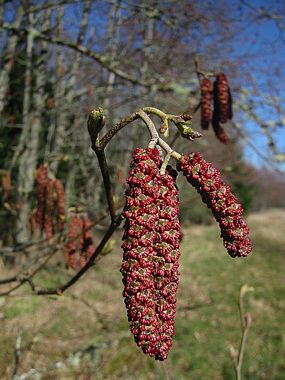
Alnus rubra (red alder) is a deciduous broadleaf tree in the Betulaceae (Birch) family native to western North America. In California it is found primarily along the coast from San Luis Obispo County northward. In southern california Alnus rhombifolia is the more commonly found alder. Red Alder is the largest species of alder in North America and one of the largest in the world, reaching heights of 20-30 meters. The official tallest red alder (1979) stands 32 meters tall in Clatsop County, Oregon (USA). The name derives from the bright rusty red color that develops in bruised or scraped bark. The bark is mottled, ashy-gray and smooth, often draped with moss. Large trees are often unbranched for a considerable distance from the ground. The leaves are ovate, 7-15 centimeter long, with bluntly serrated edges and a distinct point at the end; the leaf margin is revolute, the very edge being curled under, a diagnostic character which distinguishes it from all other alders. The leaves turn yellow in the autumn before falling. The male flowers are dangling reddish catkins 10-15 centimeter long in early spring, and female flowers are erect catkins which develop into small, woody, superficially cone-like oval dry fruit 2-3 centimeter long. The flowers are wind pollinated, and a large amount of airborne pollen is produced in early spring. The seeds develop between the woody leaves of the 'cones' and are shed in the autumn and winter.
Surface roots can be problematic if the tree receives frequent, shallow watering. Better to water deep and infrequently. Established trees with deep roots can be surprisingly drought tolerant. This is a large tree that requires plenty of space. Best suited for restoration or large gardens with bioswales or streams.
Tree
50 - 98 ft Tall
45 ft Wide
Upright
Fast
Winter Deciduous

Red, Yellow
Spring, Winter
Deep Shade, Partial Shade
High
Max 2x / month once established
Easy
Tolerates cold to 15° F
Slow
Tolerates a variety of soils as long as adequate moisture is available.
Tolerates saline soil..
Soil PH: 4.0 - 7.0
This tree is subject to infestation by mistletoe. Infected branches should be pruned out.
2, 3, 4*, 5*, 6*, 7*, 14, 15*, 16*, 17*, 20, 21, 22, 23, 24
Wet open places such as river or stream banks, pond edges, springs, and bioswales
Closed-cone Pine Forest, Mixed Evergreen Forest, Forest, Wetland-Riparian
Use with other wet-area trees and shrubs such as Cottonwood (Populus spp.), Willow (Salix spp.), Sycamore (Platanus recemosa), Monkeyflower (Mimulus cardinalis or guttatus), Yerba Mansa (Anemopsis californica), wild rose (Rosa californica), Hedge Nettle (Stachys bullata), and native ferns.
Butterflies and moths supported
60 confirmed and 70 likely
Funerary Dagger Moth
Acronicta funeralis
Triton Dagger Moth
Acronicta grisea
Common Gray
Anavitrinella pampinaria