

Carried by 3 nurseries
View Availability at NurseryData provided by the participants of the Consortium of California Herbaria
View additional distribution information on the Jepson eflora
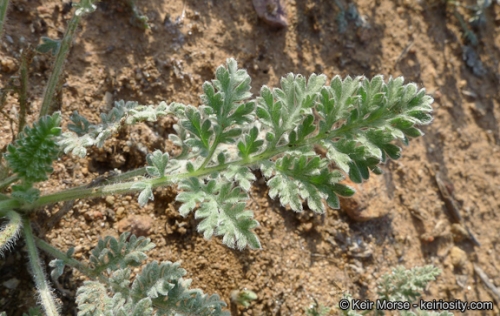
Ambrosia pumila is a rare species in the Asteraceae (Sunflower) family known by the common names San Diego Ambrosia and San Diego Ragweed. It is native to a very limited area in far southern California and Baja California where it grows in a variety of habitats along the coastal strip, inland valleys and foothills at elevations below 2,000 ft. This is a perennial herb not exceeding half a meter in height. The leaves are gray-green, fuzzy, and divided into numerous minute lobes to give a feathery appearance. They are up to 13 centimeters long, not counting the winged petioles. The flower cluster is tipped with staminate (male) flower heads above several larger pistillate (female) heads. The pistillate heads each yield usually one fruit, which is a fuzzy burr only a few millimeters wide with short, soft spines. However, it rarely produces viable seed, usually spreading by its rhizome, forming clonal groupings. It is adapted to dry habitat, but only on upper floodplain fringes, or adjoining depressions containing vernal pools or similar structures. It is a plant of open habitat and is not tolerant of heavy shade. If not given supplemental summer water it will become deciduous but will come back from the rhizome after winter rain. This is not an easy plant to find and infrequently used in residential gardens. It is important for restoration projects in areas of appropriate habitat, and it may be useful in gardens seeking to specialize in rare plants of southern California.
Perennial herb
2 ft Tall
3 ft Wide
Spreading
Fast, Moderate
Summer Semi-deciduous

Yellow, Green
Summer, Spring, Fall
Containers
Full Sun
Very Low
Max 1x / month once established
Tolerates cold to 15° F
Fast, Medium
Tolerates a variety of soils.
Propagation is by rhizome cutting, rarely from seed
Occurs primarily on upper terraces of rivers and drainages as well as in open grasslands, openings in coastal sage scrub, and occasionally in areas adjacent to vernal pools; may also be found in disturbed sites such as fire fuel breaks and edges of dirt roadways.
Chaparral, Coastal Sage Scrub, Freshwater Marsh, Valley Grassland
In the wild it is associated with Saltgrass (Distichlis spicata), Mulefat (Baccharis salicifolia), Broom Baccharis (Baccharis sarathroides), California Buckwheat (Eriogonum fasciculatum), and Turkey-mullein (Croton setiger)
Butterflies and moths supported
0 confirmed and 15 likely
Garden Webworm Moth
Achyra rantalis
Ambrosia Plume Moth
Adaina ambrosiae
Bordered Patch
Chlosyne lacinia