

Carried by 12 nurseries
View Availability at NurseryData provided by the participants of the Consortium of California Herbaria
View additional distribution information on the Jepson eflora
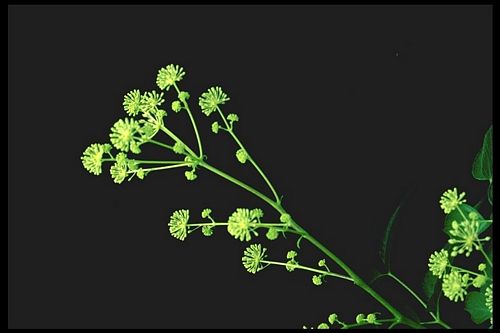
Aralia californica, known by the common name elk clover though not actually a clover, is a large herb in the family Araliaceae, the only member of that family native to California and southwestern Oregon. It is a deciduous herbaceous perennial plant growing to a height of 2-3 meters on stems which are thick but not woody. The stems bear large green pinnate or bipinnate leaves 1-2 meters long and 1 meter broad, the leaflets 15-30 centimeter long and 7-15 centimeter broad. The greenish white flowers are produced in large, ball-shaped compound umbels 30-45 centimeter diameter at the stem tip; each star-shaped flower is 2-3 millimeter diameter, and matures to small (3-5 millimeter) dark purple or black fruit, each berry containing 3-5 seeds. This plant performs best under trees or in other moist, shady areas.
Perennial herb
7 - 10 ft Tall
10 ft Wide
Winter Deciduous

White, Green
Summer, Fall
Deer resistant
Deep Shade, Partial Shade
High, Moderate
Max 1x / month once established
Moderate
Tolerates cold to 5° F
Medium
Tolerates a variety of soils.
Tolerates serpentine soil..
Soil PH: 4.0 - 7.0
For propagating by seed: No treatment.
3, 4, 5*, 7*, 8, 9, 14, 15, 16*, 17*, 18, 19, 20, 21, 22, 23
Moist forested canyons, streamsides
Chaparral, Foothill Woodland, Valley Grassland, Yellow Pine Forest, Wetland-Riparian
Use under trees such as Coast Redwood (Sequoia sempervirens), Firs (Abies spp.), Maples (Acer spp.), Pines (Pinus spp.), Bay Laurel (Umbellularia californica), Chinquapin (Chrysolepis chrysophylla or sempervirens), and Tanoak (Notholithocarpus densiflorus), along with other shade-loving and moisture loving plants such as native ferns, Wild Ginger (Asarum caudatum), Columbine (Aquilegia formosa), Chinese Houses (Collinsia heterophylla), Larkspur (Delphinium spp.), Bleeding Heart, and Bigflower Tellima (Tellima grandiflora).
Butterflies and moths supported
0 confirmed and 3 likely