

Carried by 4 nurseries
View Availability at NurseryData provided by the participants of the Consortium of California Herbaria
View additional distribution information on the Jepson eflora
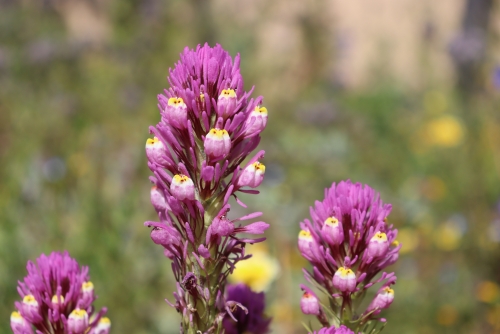
Purple owl's clover (Castilleja exserta) is an annual in the same species as the Indian paintbrushes. It was formerly included in the genus Orthocarpus, and some sources may still refer to it by that name. Although this species is variable in appearance and easily hybridizes with other Castilleja, it generally bears shaggy pink-purple or lavender flower clusters that resemble clover (though they are not related). The thin, erect leaves are usually tipped with the same color, giving the flower cluster the appearance of a paintbrush. It produces pods containing seeds.
The plant's showy appearance when in flower makes it a great fit for informal meadows and related landscapes. Like other related plants in the family, purple owl's clover derives some of its nutrients directly from the roots of other plants. Therefore, it is almost always planted, or grown from seed, with a perennial species from its natural plant community to serve as the host plant, such as a native grass. It takes full sun, prefers fast-draining soil but is tolerant of sand and clay. It does not need summer water.
The flowers attract bees and butterflies. It is a crucial host plant for the Bay Checkerspot butterfly, a threatened species in California, and hosts a likely total of 12 species of butterfly and moth.
Annual herb
2 ft Tall
1 ft Wide
Fast, Moderate

Lavender, Pink, Purple, White
Spring
Full Sun
Very Low, Low
Moderate
Tolerates cold to 15° F
Fast, Medium, Slow
Tolerant of sand and clay, prefers fast-draining soil.
Soil PH: 5.0 - 8.0
By seed. It must be planted with a perennial host plant such as a native grass (Stipa, Fescue, or other species). Some propagation protocols also recommend Beardtongue (Penstemon spp.), Common Spikeweed (Hemizonia pungens), Low Barley (Hordeum depressum), or Alkali-Sink Goldfields (Lasthenia chrysantha).
Grasslands and openings in chaparral or woodlands; occasionally in desert areas
Chaparral, Coastal Sage Scrub, Coastal Strand, Creosote Bush Scrub, Foothill Woodland, Joshua Tree Woodland, Northern Coastal Scrub, Valley Grassland
Use in a meadow-like planting with other annuals such as Clarkis spp., California Poppy (Eschscholzia californica), Baby Blue-eyes (Nemophila menziesii), and Lupine (Lupinus spp.); also with geophytes such as wild onions (Allium spp.), Ithuriels's Spear (Triteleia laxa), Blue Dicks (Dichelostemma capitatum), and Mariposa Lily (Calochortus spp.).
Butterflies and moths supported
6 confirmed and 12 likely
Variable Checkerspot
Euphydryas chalcedona
Bay Checkerspot
Euphydryas editha bayensis
Common Buckeye
Junonia coenia
Gray Buckeye
Junonia grisea