

Carried by 0 nurseries
View Availability at NurseryData provided by the participants of the Consortium of California Herbaria
View additional distribution information on the Jepson eflora
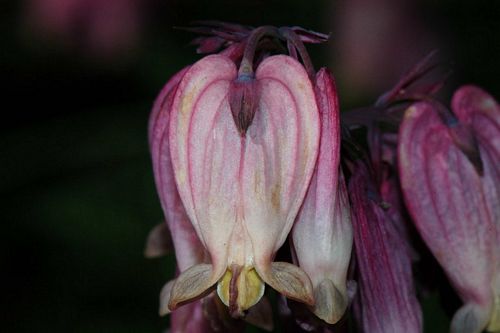
Pacific Bleeding Heart (Dicentra formosa ssp. formosa) is the more common subspecies of Dicentra formosa. It is a native perennial herb that grows in central and northern California. Leaves are finely divided and fernlike, growing from the base of the plant. Flowers are pink, red, or white and heart-shaped and bloom in clusters at the top of leafless, fleshy stems above the leaves from mid-spring to autumn, with peak flowering in spring. The four petals are attached at the base. The two outer petals form a pouch at the base and curve outwards at the tips. The two inner petals are perpendicular to the outer petals and connected at the tip. There are two tiny, pointed sepals behind the petals. Seeds are borne in plump, pointed pods. The plant self-seeds readily. It frequently goes dormant for the summer after flowering, emerging and flowering again in autumn.
This species is frequently confused with and sold as Dicentra eximia, which has narrower flowers and longer, more curved outer petal tips. D. formosa is related to Lamprocapnos spectabilis, another popular plant called "bleeding heart", which was formerly placed in the same genus. There are two subspecies: Ssp. formosa has leaves glaucous beneath and never glaucous above, flowers purple pink to pink or white. It grows on the western slope of Sierra Nevada, Coast Ranges to central California, Cascades, extreme southwestern British Columbia. Ssp. oregana has leaves that are glaucous above and beneath, flowers cream or pale yellow. It grows in a small area of northwestern California and southwestern Oregon.
In warmers areas in its range, it prefers shade. In cooler areas in its range, it prefers more sun.
Perennial herb
2 ft Tall
3 ft Wide
Winter Deciduous

Pink, Red, White
Summer
Full Sun, Partial Shade, Deep Shade
High, Moderate
Max 3x / month once established
Tolerates cold to 5° F
Medium
.
Soil PH: 5.0 - 8.0
Divisions of the rootstock. For propagating by seed: 3 mos. stratification.
Damp areas
Northern Oak Woodland, Red Fir Forest, Redwood Forest, Yellow Pine Forest
Trees - Ponderosa Pine (Pinus ponderosa), Tanoak (Notholithocarpus densiflorus), Madrone (Arbutus menziesii), Oak (Quercus spp.), Coast Redwood (Sequoia sempervirens), Dogwood (Cornus spp.)
Other Plants - Maidenhair Fern (Adiantum spp.), Deer Fern (Blechnum spicant), Horsetail (Equisetum spp.), Polypody Fern (Polypodium spp.), Sword Fern (Polystichum spp.), Meadow Rue (Thalicturm species), Yerba Buena (Clinopodium douglasii), Western Columbine (Aquilegia formosa), Monkeyflower (Mimulus cardinalis or guttatus)
Butterflies and moths supported
0 confirmed and 1 likely
Clodius Parnassian
Parnassius clodius