

Carried by 37 nurseries
View Availability at NurseryData provided by the participants of the Consortium of California Herbaria
View additional distribution information on the Jepson eflora
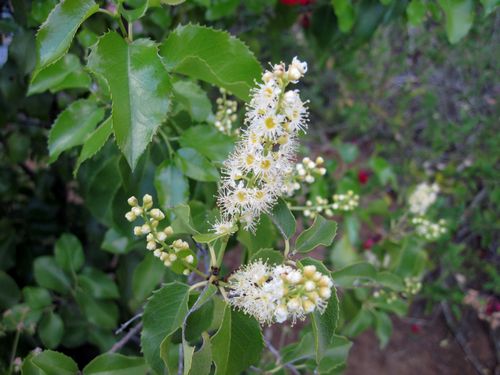
Hollyleaf cherry or Evergreen cherry is a species in the Rosaceae (Rose) family that is native to coastal California and northern Baja California. It is an evergreen shrub or small tree up to 15 meters tall, with dense, sclerophyllous foliage. The leaves are 1.6-12 centimeter long with a 4-25 millimeter petiole and spiny margins, somewhat resembling those of the holly, hence its English name; they are dark green when mature and generally shiny on top, and have a smell resembling almonds when crushed. The flowers are small (1-5 millimeters), white, produced on racemes in the spring. The fruit is a cherry 12-25 millimeter diameter, edible and sweet, but contains little flesh surrounding the smooth seed. Great for birds.
There are two recognized subspecies; ssp. lyonii (commonly known as Catalina Island Cherry) is native to the Channel Islands. It was formerly considered a separte species, and it is very similar in appearance and genetics to other P. ilicifolia. They hybridize readily, and many plants sold in nurseries may be unintentional hybrids.
Tree, Shrub
30 - 49 ft Tall
20 ft Wide
Rounded, Upright Columnar
Fast, Moderate
Evergreen

Cream, White
Spring, Winter
Bank stabilization, Hedge
Full Sun, Partial Shade
Very Low, Low, Moderate
Max 1x / month once established
Easy
Tolerates cold to 15° F
Fast, Medium
Tolerant of a variety of soils but will grow largest and fastest in coarse, fast draining, relatively fertile garden soil.
Soil PH: 5.0 - 8.0
For propagating by seed: Fresh seeds need no treatment; stored seeds 1-3 mos. stratification may improve germination.
Slopes of the coast-facing mountains, extending inland to the desert transition and 1, 600 m elevation
Chaparral, Foothill Woodland
Works with a wide variety of other trees and plants, including Manzanita (Arctostaphylos spp.), Coyotebrush (Baccharis pilularis), Barberry (Berberis spp.), Ceanothus spp., Redbud (Cercis occidentalis), Tree Poppy (Dendromecon rigida), Toyon (Heteromeles arbutifolia), Bushmallow (Malacothamnus fasciculatus), Pines (Pinus spp.), Oak (Quercus spp.), Flannelbush (Fremontodendron spp.), Currant (Ribes spp.), and many others.
Butterflies and moths supported
4 confirmed and 140 likely
Pale Swallowtail
Papilio eurymedon
Western Tiger Swallowtail
Papilio rutulus
Elegant Sphinx Moth
Sphinx perelegans