

Carried by 30 nurseries
View Availability at NurseryData provided by the participants of the Consortium of California Herbaria
View additional distribution information on the Jepson eflora
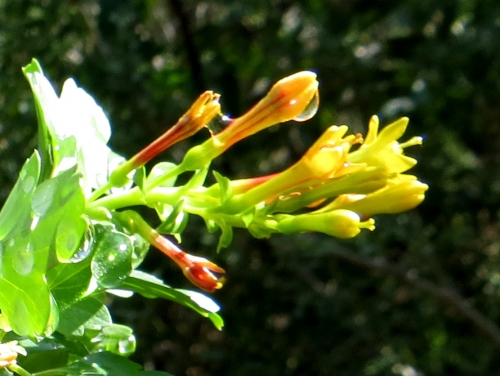
Ribes aureum var gracillimum, known by the common name Golden Currant, is a species of small to medium-sized deciduous shrub that grows 3-6 feet tall. It's native to the coast and foothill regions of California, growing most commonly in the southern foothills of the Transverse Range, and more rarely in the coastal ranges as far as the Mendocino National Forest. It blooms in spring with racemes of conspicuous golden yellow flowers, often with a pronounced fragrance similar to that of cloves or vanilla. The flowers attract hummingbirds and monarch butterflies. Leaves are green, shaped similarly to gooseberry leaves, turning red in autumn. The plant is deciduous from late December to early February. The shrub produces berries about half an inch in diameter from an early age. Ripe fruits, amber yellow to black in color, are tasty, and attract a wide range of birds.
While Golden Currants are fairly drought tolerant once mature, they grow best in areas with somewhat more ground water, such as the bottom of slopes, near creeks or canyon bottoms, or near irrigated areas. On the coast, they prefer full sun, and inland, part shade. They do best when surrounded by mulch, and grow well under oak trees and in mixed chaparral. When Golden Currants are thriving, they self-seed and spread out from the original plant and can serve as a groundcover.
Shrub
3 - 6 ft Tall
3 - 6 ft Wide
Spreading
Moderate
Evergreen, Winter Deciduous
Pleasant

Yellow
Winter, Spring
Groundcover, Deer resistant
Full Sun, Partial Shade
Low, Very Low
Max 1x / week once established
Tolerates cold to -15 - 0° F
Fast, Medium, Slow
Variable.
Soil PH: 6 - 8
6*, 7, 8, 9, 10, 14*, 15*, 16*, 17*, 18*, 19*, 20*, 21*, 22*, 23*, 24*
Found in a variety of settings and habitats most often slope bottoms, creek sides, bottoms of slopes adjacent to wetland-riparian, moister areas in oak woodlands, chaparral. Occasionally also found in drier settings such as sagebrush scrub, woodlands (oak, juniper, pine), or at higher elevations in fir or pine forest
Chaparral, Foothill Woodland, Oak Woodland, Wetland-Riparian
Oaks (Quercus spp.), Cottonwoods (Populus spp.), Manzanita (Arctostaphylos spp.), Mulefat (Baccharis salicifolia), Sedges (Carex spp.), Ceanothus species, Brown Dogwood (Cornus glabrata), Honeysuckle (Lonicera spp.), Monkeyflower (Mimulus spp.), Flaxleaf Monardella (Monardella linoides), Hollyleaf Cherry (Prunus ilicifolia), California Wild Rose (Rosa californica), Hummingbird Sage (Salvia spathacea), Blue-eyed Grass (Sisyrinchium bellum)
Butterflies and moths supported
0 confirmed and 72 likely
Milbert's Tortoiseshell
Aglais milberti
Western Avocado Leafroller Moth
Amorbia cuneana