

Carried by 7 nurseries
View Availability at NurseryData provided by the participants of the Consortium of California Herbaria
View additional distribution information on the Jepson eflora
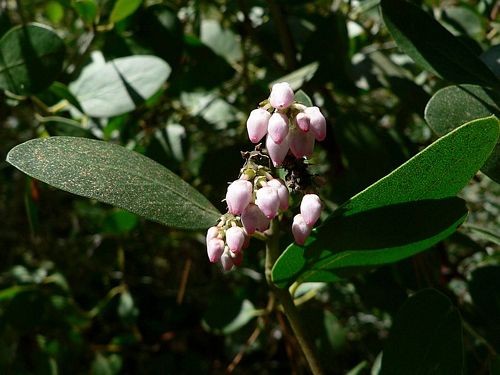
Arctostaphylos patula is a species in the Ericaceae (Heath) family known by the common name Greenleaf Manzanita. This is a shrub of the Sierras and Klamath mountains, living at higher elevations and tolerating very cold winters. It reaches between one and two meters in height. Like other Manzanitas its lower branches extend more outward than upward and may root in the soil where they touch. The stems are twisting and reddish-brown in color, and shiny due to hairy secretion. The leaves are oval-shaped to nearly round, and flat, shiny, and smooth. They are 6 centimeters long and four wide at maximum. The plentiful flowers are white to pink and urn-shaped, each with five small lobes at the mouth of the corolla, hanging in bunches. The fruits are dark brown drupes nearly a centimeter wide, each containing about five hard-coated seeds. Seeds require fire followed by cold conditions to germinate; seeds can remain dormant in soil for hundreds of years. In a few areas Greenleaf Manzanitas produce lignotubers from which they can reproduce vegetatively. In the garden this plant seems to tolerate many conditions. However, it is not tolerant of alkaline soil.
Shrub
3 - 7 ft Tall
9 ft Wide
Upright, Mounding
Slow
Evergreen

Pink, White
Spring, Winter
Hedge
Full Sun, Partial Shade
Low
Moderate
Tolerates cold to -10° F
Fast
Typically decomposed granite.
Soil PH: 5.0 - 7.5
For propagating by seed: Soak in concentrated H2SO4 for 2 hrs. then 3 mos. stratification (Carlson and Sharp 1975); or concentrated H2S04 for 4 hrs. then 4 mos. stratification ( USDA Forest Service 1974). For the acid treatment, single nutlets and stone pieces (often without embryos) and entire stones should be treated separately, as they require different amounts of time in acid (Giersback 1937) An alternate method is fire treatment in fall, this gives germination by spring. More easily propogated from tip cuttings in winter using bottom heat.
1, 2, 3, 7, 14, 15, 16, 18
Often found growing among granite boulders in forest openings or treeless places at higher elevations
Lodgepole Forest, Red Fir Forest, Yellow Pine Forest
Trees: White Fir (Abies concolor), Red Fir (Abies magnifica), Desert Mountain Mahogany (Cercocarpus ledifolium), Dogwood (Cornus spp.), Western Juniper (Juniperus occidentalis), Tanoak (Notholithocarpus densiflorus), Ninebark (Physocarpus capitatus), Pinus spp., Quaking Aspen (Populus tremuloides), Canyon Oak (Quercus chrysolepis),
Shrubs: Mountain Grape (Berberis aquifolium), Ceanothus spp., Buckwheat (Eriogonum spp.), Coffeeberry (Frangula spp.), Honeysuckle (Lonicera spp.), Western Labrador Tea (Rhododendron columbianum), and Huckleberry (Vaccinum spp.)
Butterflies and moths supported
20 confirmed and 34 likely
To learn more, visit the Jepson Herbarium's YouTube channel and watch a short video about this species: https://www.youtube.com/watch?v=4bKeWAUPEBM