

Carried by 33 nurseries
View Availability at NurseryData provided by the participants of the Consortium of California Herbaria
View additional distribution information on the Jepson eflora
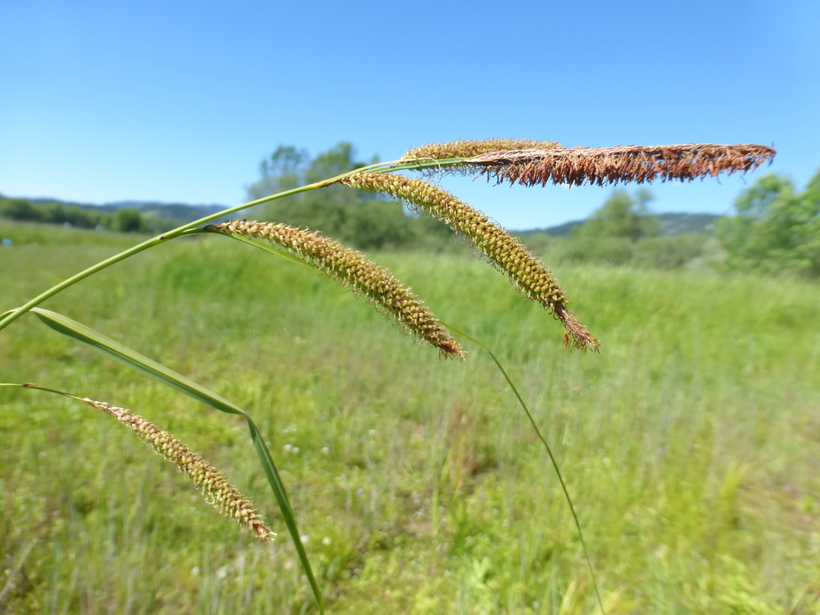
Carex barbarae is a species in the Cyperaceae (Sedge) family known by the common names Valley Sedge and Santa Barbara Sedge. Despite its common name it is not limited to the Santa Barbara area and is native to a large part of California and Oregon, where it grows in wet and seasonally wet habitat, such as meadows and riverbanks. This sedge produces angled, hairless stems up to one meter tall or slightly taller. The tough leaves are narrow with shredding, red-spotted or purple basal sheaths. The flower cluster produces erect and drooping spikes up to about 8 centimeters long with an associated long leaf which exceeds the length of the spikes. The fruits are covered in a sac called a perigynium which is light to dark brown and sometimes red-spotted, leathery and tough, and sometimes with a toothed, hairy tip. The plant rarely matures into a fruiting stage, however, with most individuals remaining sterile. Parts of this sedge are used in basketry and as sewing fiber by California Native American groups such as the Maidu and Pomo. Use caution in deciding where to use this plant because it can be an aggressive spreader wherever there is moisture. Its tendency to spread can be controlled by planting in a container. It is useful on the margin of a pond or in a bioswale.
Grass
2 - 3 ft Tall
3 ft Wide
Fountain
Fast
Evergreen
None

Cream, Purple, Red
Summer
Containers, Deer resistant, Water features or wet habitats
Partial Shade
Low, Moderate, High
Max 1x / week once established
Tolerates cold to 15° F
Slow
Tolerates a variety of soils.
Soil PH: 5.5 - 8.0
4*, 5*, 6*, 7*, 8*, 9*, 14*, 15*, 16*, 17*, 18*, 19*, 20*, 21*, 22*, 23*, 24*
Seasonally wet places
Coastal Prairie, Foothill Woodland, Mixed Evergreen Forest, Valley Grassland, Wetland-Riparian
Use with other wetland and bog plants such as Yerba Mansa (Anemopsis californica), Brodiaea spp., Flatsedge (Cyperus spp.), Spikerush (Eleocharis spp.), Stream Orchid (Epipactis gigantea), Coast Gumweed (Grindelia stricta), Juncus spp., Iris spp., Monkeyflower (Mimulus cardinalis or guttatus), Hedge Nettle (Stachys spp.), Vervain (Verbena lasiostachys), and Willow (Salix spp.)
Butterflies and moths supported
0 confirmed and 8 likely
American Ear Moth
Amphipoea americana
Common Ringlet
Coenonympha tullia
Olive Green Cutworm Moth
Dargida procinctus