

Carried by 4 nurseries
View Availability at NurseryData provided by the participants of the Consortium of California Herbaria
View additional distribution information on the Jepson eflora
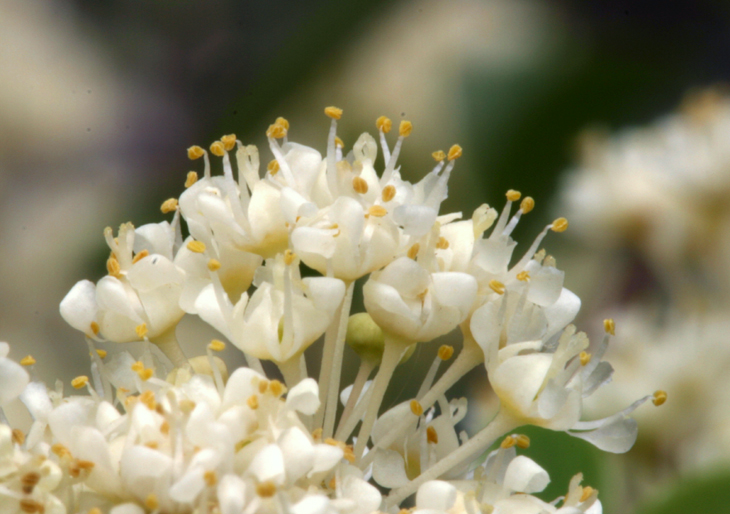
Ceanothus cordulatus is a species of shrub in the buckthorn family (Rhamnaceae) known by the common names Mountain Whitethorn and Whitethorn Ceanothus. It is native to California and adjacent sections of Oregon, Nevada, and Baja California, where it grows on mountain ridges and other forested areas. In California its major population is in the Sierras. This is a spreading shrub growing usually wider than tall and up to about 1.5 meters. The stems are gray, with the twigs yellow-green in color and fuzzy in texture when new. The evergreen leaves are alternately arranged and up to 3 centimeters long. Each is oval in shape with three ribs and generally not toothed. The leaves may be hairy or not. The flower cluster is panicle-shaped, up to about 4 centimeters long. The flowers are white to off-white with five sepals and five petals. The fruit is a rough, ridged capsule up to half a centimeter long. It has three valves inside, each containing a seed. This is a plant for high elevation gardens, from 4,000 ft. to 10,000 ft. At lower elevations it grows slowly and performs poorly. It is one of the most cold-tolerant of the Ceanothus.
Shrub
3 - 6 ft Tall
9 ft Wide
Upright, Spreading
Fast, Slow
Winter Deciduous, Winter Semi-deciduous, Evergreen
Pleasant

White, Cream
Summer, Winter, Spring
Bank stabilization, Hedge
Full Sun, Partial Shade
Very Low
Tolerates cold to -20° F
Fast, Medium, Slow
Prefers sandy or loamy soils. Does not grow well in clay soils.
Soil PH: 5.0 - 7.0
For propagating by seed: Hot water and 3 mos. stratification. Alternative treatment: boil in water 1 min.; then, instead of stratification, soak in 400 ppm GA, 13 hrs.; air dry 4 days; soak in 3% thiourea 5 mins. Seeds may then be sown or dried again and stored. In this quick treatment gave 25% germination for Ceanothus cordulatus. (Adams et al. 1961).
1, 2, 3, 6, 7, 14, 15, 16, 18
Rocky ridges, open areas in higher elevation mountains.
Lodgepole Forest, Red Fir Forest, Yellow Pine Forest
Use with other mountain species such as Firs (Abies spp. and Pseudotsuga spp.), Manzanita (Arctostaphylos mewukka or nevadensis or patula), Dogwood (Cornus spp.), Western Juniper (Juniperus occidentalis), Tanoak (Notholithocarpus densiflorus), Ninebark (Physocarpus capitatus), Pines (Pinus spp.), Quaking Aspen (Populus tremuloides), Canyon Live Oak (Quercus chrysolepis), and Giant Redwood (Sequoiadendron giganteum)
Butterflies and moths supported
6 confirmed and 77 likely
Pacuvius Duskywing
Erynnis pacuvius
Ceanothus Silkmoth
Hyalophora euryalus
Western Tent Caterpillar
Malacosoma californica
California Tortoiseshell
Nymphalis californica