

Carried by 28 nurseries
View Availability at NurseryData provided by the participants of the Consortium of California Herbaria
View additional distribution information on the Jepson eflora
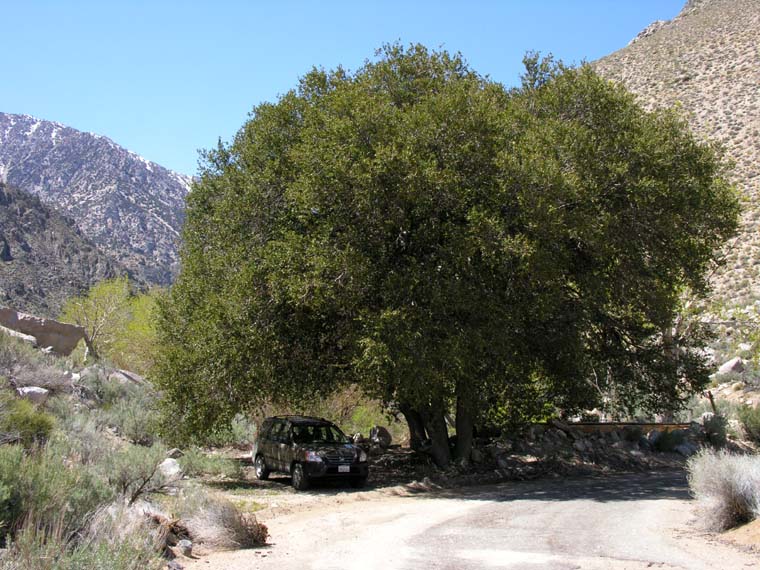
Canyon live oak is a species of evergreen oak that is found in the southwestern part of North America, notably in the California Coast Ranges. It is the most wide-spread oak in the state. Its ultimate size and shade are determined by its location within the state. This tree is often found near creeks and drainage swales growing in moist cool microhabitats. Its leaves are a glossy dark green on the upper surface with prominent spines; a further rapid identification arises from the leaves of Canyon live oak being geometrically flat. They are often sympatric with Quercus agrifolia and several other oak species. Fossil data supports a much wider distribution throughout the western United States during the early Holocene period. Native Americans used the acorns of this species as a food staple, after leaching of the tannins; moreover, its roasted seed is a coffee substitute. After forest fires, Canyon live oak regenerates vigorously by basal sprouting, and the clonal diversity of this species has been shown to be high. Alternate common names for this taxon are Canyon oak and "Golden-Cup Oak".
Tree, Shrub
30 - 90 ft Tall
30 - 60 ft Wide
Upright, Rounded, Upright Columnar
Moderate, Slow
Evergreen

Yellow, Cream, Green
Spring, Winter
Bank stabilization, Deer resistant
Full Sun, Partial Shade, Deep Shade
Low, Very Low
Max 2x / month once established
Moderate
Tolerates cold to -15° F
Medium
Found in a wide variety of soils in various parts of the state.
Soil PH: 5.0 - 7.0
For propagating by seed: Fresh seeds sow in fall outdoors or stratify to hold for spring sowing. If started indoors or in glasshouse, stratify first for .5-2 mos. (USDA Forest Service 1974).
1, 2, 3, 4*, 5*, 6*, 7*, 8, 9*, 10, 11, 14*, 15*, 16*, 17*, 18*, 19*, 20*, 21*, 22*, 23*, 24
Because this tree is so widely distributed around the state, its natural setting can vary considerably. It is most often found in foothills and canyons up to 9, 000 ft., sometimes on north facing slopes or among boulder fields. Climates varies from very wet to semi-arid
Chaparral, Foothill Woodland, Lodgepole Forest, Red Fir Forest, Valley Grassland, Yellow Pine Forest
Because it is found over such a large part of the state, companion plants can vary considerably. Often found in mixed woodlands with Madrone (Arbutus menziesii), Bay Laurel (Umbellularia californica), Douglas Fir (Pseudotsuga menziesii), Bigcone Spruce (Pseudotsuga macrocarpa), Ponderosa Pine (Pinus ponderosa), Jeffrey Pine (Pinus jeffreyi), and Sugar Pine (Pinus lambertiana).
Butterflies and moths supported
14 confirmed and 165 likely
California Sister
Adelpha californica
Ophelia Underwing
Catocala ophelia