

Carried by 38 nurseries
View Availability at NurseryData provided by the participants of the Consortium of California Herbaria
View additional distribution information on the Jepson eflora
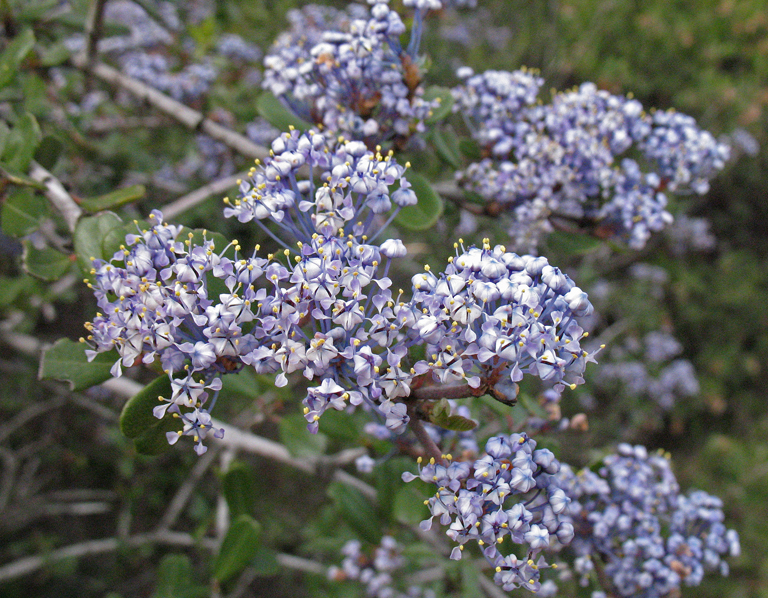
Buckbrush (Ceanothus cuneatus) is a flowering shrub in the Buckthorn family that is one of the most common and widespread native plants in California. It flowers abundantly in spring, bearing rounded bunches of tiny white flowers that are sometimes tinted strongly with blue or lavender. It is a spreading bush, rounded to sprawling with evergreen leaves that are stiff, tough and fleshy. The fruit is a tiny round capsule with horns. This plant may vary in appearance due to its wide distribution and because it hybridizes easily with similar species.
Buckbrush is tough and drought adapted. It takes full sun and is adaptable to different types of soil so long as it is well-draining. It will even grow well in serpentine soil. It is recommended as both an informal hedge and a garden focus.
It supports insects, especially bees. Butterflies are attracted to the flowers and are known to host 9 species of butterfly and moth with a huge total of 86 species likely. Harvester ants have been known to cache the seeds, which can lie dormant for a long time since fire is required for germination.
Shrub
5 - 12 ft Tall
5 - 12 ft Wide
Upright, Rounded, Spreading
Fast, Moderate
Evergreen
Pleasant

White
Summer, Spring, Winter
Bank stabilization, Hedge
Full Sun
Very Low, Low
Max 1x / month once established
Moderate
Tolerates cold to -10 - 0° F
Fast
Variable but needs fast drainage.
Tolerates serpentine soil..
Soil PH: 6 - 8
For propagating by seed: Hot water and 3 mos. stratification. Alternative treatment: boil in water 1 min.; then, instead of stratification, soak in 400 ppm GA, 13 hrs.; air dry 4 days; soak in 3% thiourea 5 mins. Seeds may then be sown or dried again and stored. This quick treatment gave 41% germination for Ceanothus cuneatus. (Adams et al. 1961).
Dry fans, slopes, ridges
Chaparral, Pinyon-Juniper Woodland, Yellow Pine Forest
Gray Pine (Pinus sabiniana), Pinyon Pine (Pinus monophylla), Ponderosa Pine (Pinus ponderosa), Blue Oak (Quercus douglasii), Johnny Jump Up (Viola pedunculata), Manzanita (Arctostaphylos spp.), Coffeeberry (Frangula spp.)
Butterflies and moths supported
9 confirmed and 86 likely
Fruit-Tree Leafroller Moth
Archips argyrospila
The Brown Elfin
Callophrys augustinus
Western Tent Caterpillar
Malacosoma californica
California Tortoiseshell
Nymphalis californica